Showing posts with label China. Show all posts

Saturday, November 26, 2011

Medicine king of Jiangnan

Rising from rags to riches, Hangzhou merchant Hu Xueyan built a pharmaceutical business that continues to flourish today. 

THERE is a late Qing dynasty residence in Hangzhou that is remarkable not only for its sheer size and its fine restoration but even more so for the fact that it is hardly, if ever, featured in the famous city’s tour itineraries.
As with all things important in Hangzhou, the mansion (or properly, manor) is situated not far from the iconic West Lake around which everything in the city seems to revolve.
The property’s original owner was a merchant named Hu Xueyan (1823-1885) who, in the late 1800s, was one of the richest men in China.
Sign of wealth: Calligraphy panels extolling the virtues of kindness and charity adorn the imposing main gate of Hu Xueyan’s manor.
Born into poverty in neighbouring Anhui province, Hu started as an apprentice in a Hangzhou bank and subsequently built up a thriving banking business. He later expanded into trading silk, tea and armaments, and finally into Chinese traditional medicine, all the while cultivating mutually beneficial relationships with high-ranking officials.
It is said that in his heyday, Hu possessed more silver than the moribund Qing dynasty, and he helped the official Zuo Zongtang pay soldiers’ salaries as well as procured provisions and ammunitions for his campaigns against the rebellions that wracked China in the late 19th century. He also generously donated money, clothing, seed stocks, rice and medicine to victims of natural disasters in various provinces.
Hu’s star rose even higher when Zuo recommended him to the Qing court and he was made an official of the second grade, just one level beneath the highest rank in the imperial bureaucracy.
Concealed behind rather plain enclosure walls several metres high, the residence that Hu built in 1872 sprawls over an astonishing 5,815sqm and comprises 13 buildings set amongst gardens, ponds and rockeries. The occupant’s wealth and status is immediately evident from the size, height and width of the manor’s soaring front porch which is designed to accommodate a sedan chair so big it had to be carried by eight men, a privilege which Hu, a grade 2 official was entitled to enjoy.
The luxurious manor was constructed using at least six types of rare and expensive wood, including cedar and sandalwood, as well as materials ranging from stone to brick to clay, much of which, like the stone lintel above a pair of doors just beyond the main gate, is intricately carved.
Huqingyutang medical hall’s plain entrance gives little hint of its grand interior.
Hu’s primary wife and mother lived in the central hall as befitting their status while the 12 secondary wives and 19 children were consigned to the wings. There is a terrace for opera performances in one of the gardens as well as a raised gazebo from which the master, his family and friends could enjoy the entertainment.
Hu was reputedly worth 20 million taels of silver at his peak, a fortune which he presumably stored in his “vault”, an underground cellar beneath one of the halls.
There is an abundance of blue glass windows throughout the mansion, an expensive foreign luxury in Hu’s day, plus an extravagant use of copper, some 20 tons of it according to our guide, for fixtures and fittings. Besides window hinges, latches, and huge water storage jars, even gutters and drain pipes were made of copper, though all but one has disappeared.
Further, in a house full of women, a copper “telephone” conduit leading directly to the wives’ quarters enabled the master of the house to speak privately with each of them.
In a side street off Hangzhou’s Hefangjie is the medicinal herb shop Hu Xueyan established in 1874, now designated a Traditional Chinese Medicine (TCM) Museum. Called Huqingyutang, one would never have guessed its importance from the simple stone entrance gate just across from a well-known scissors shop. Covered corridors lead to the beautifully maintained retail hall, a stunning double storey atrium ornately decorated in Qing dynasty style with a multitude of lanterns, carved wooden beams and calligraphy panels.
The pharmacy built its reputation on its founder’s three-pronged motto of “benevolence, avoiding deception, and fixed price”. Backed by the time-honoured values of honesty and fairness, prices were non-negotiable as they were commensurate with the high quality of the establishment’s products. Hu’s business principles proved highly successful, so much so that he is sometimes dubbed “Medicine king of Jiangnan (south of the Yangtze River)”.
Huqingyutang is a living museum, bustling with pharmacists in white coats and caps busy preparing and portioning dried herbs from the well-stocked counters and drawers, much as they would have done over a century ago. Medicinal herbs like ginseng and other traditional preparations are available for sale. In addition the company now has a modern factory producing Chinese medicine for all sorts of ailments and even an online shop and consultation service.
Hu Xueyan and Huqingyutang are evidently not unknown in China, especially since a television drama was made about his life a few years ago. This makes it all the more surprising that we were able to enjoy his lavish estate and impressive pharmacy without the usual crowds that throng famous sites in the country.

Source: thestar.com.my

Friday, June 3, 2011

Self-made billionaire-Xiaofeng Peng

China. Age: 34

Xiaofeng Peng is a self-made billionaire with an estimated worth of $1.5 billion. Solar energy has been his ladder to success and wealth. When Peng was pondering the next move of his career, he realized that renewable energy is the future. Initially, he started out with a trading company in 2005, and it grew immensely to become one of the fastest growing suppliers of Chinese-made solar wafers in the world. These solar wafers are used in solar panels. His company, LDK Solar has also been listed on NASDAQ since 2007.

He graduated from Jiangxi Foreign Trade School in 1993 and went on to earn a diploma in international business from Beijing University Guanghua School of Management as well as an MBA degree in 2002. Prior to founding this company, he also founded Suzhou Liouxin, which is a leading manufacturer of personal protective equipment in Asia.

Xiaofeng Peng is also fluent in Japanese and traveled America and Europe extensively. He is a man with a big vision and has built a company of more than 12,000 people, which continues to grow. As part of his next
phase of expansion plans, LDK Solar has recently given a $220 million contract to Applied Materials Inc., for providing precision wafering systems.

Peng states that he aims at making his company the largest and the most economic silicon wafer supplier in the world and he intends to do that both in terms of market share and sales volume.

Thursday, June 2, 2011

From rags to riches - Yu's 'American dream'

His father was a peasant and carpenter, and 44-year-old Yu Minhong will never forget watching him collect bits of waste brick and stones and stack them up in the small courtyard of their rural home.


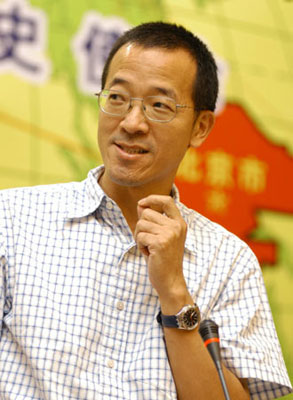
Yu Minghong, President of New Oriental School.

What use was all this rubble and debris? The day Yu saw his father transform the stones into a small pen to shut in the pigs, hens and ducks, he was amazed. At that time, his family could not afford to buy bricks.

Yu says his his father's practical determination and foresight have influenced his whole life.

"If you have a map in your head, you can always turn stones into a building." "If a pyramid was dismantled, it would just be a pile of stones. If you live your life without an aim, it's just a heap of days."

Yu Minhong, or Michael Yu, epitomizes the rags to riches trajectories of those who have been able to grasp opportunities in rapidly changing China.

He said his father's patient stone-piling lesson had influenced him at three critical junctures of his career: he piled up days and days of hard work to eventually secure admission to university after two failures; he made a collection of English words so that he could become a university English teacher; he started his own English training school. Yu's training school, which has surfed on the obsession for studying English, has since helped hundreds of thousands of Chinese students get into U.S. universities.

The company, New Oriental Education and Technology Group, was listed on the New York Stock Exchange in September, the first private education company to achieve this feat. Yu is thought to be China's richest teacher with about 2 billion yuan (250 million U.S. dollars) of assets.

"I'm not excited at the news. It's not a miracle, but a natural result of our efforts over the past 13 years. It's just a milestone along the way. There is still a long way to go. We have to walk straighter, for many more people are watching us now," Yu says.

The bespectacled and smiling man enjoys encouraging students with Martin L. King's line from his speech "I Have a Dream." He made it a credo for the New Oriental schools.

"We will hew out of the mountain of despair a stone of hope." Founded in 1993, New Oriental has grown from a class of only 30 students to China's largest private education service provider with more than three million student enrollments.

It has a network of 25 schools and 111 learning centers in 24 cities as well as an on-line network that has attracted 2 million registered users. Clearly, teaching English can make people rich in China. Like many of his peers,

Yu wanted to pursue an American Dream in the late 1980s, but failed repeatedly to obtain a visa. Stymied in his American ambitions, he started to cash in on helping others fulfill their American Dreams.

He quit a stable job as an English teacher at Beijing University and started up a business to help students develop their English skills. Yu's company no longer only teaches English.

His business has extended to other foreign language training, preparing students for tests, primary and secondary school education and software as well as on-line education. "Instilling a certain spirit in students is as important as giving them a skill," Yu says.

Yu is trying to inspire students by inviting high achievers -- including moguls from real estate, the dairy industry or advertising -- to talk about their individual road to success. "We are committed to training a new generation of business and community leaders, empowering students to achieve their potential, build self-confidence, and develop a global vision encompassing both traditional Chinese values and modern thinking," Yu says.

While he encourages students to try various paths to success, Yu would never call himself successful.

"A career must always develop and so must a man. You can never call a living man a success, it is only when he goes to his eternal rest that a judgment can be made," Yu says.

"My next aim is to build New Oriental into a model for China's private education," says Yu, who sports a crew cut and casual wear in his office in northwestern downtown Beijing.

Private education is not new in China. Confucius is said to have started the tradition of private education in the 6th century B.C.. Chinese entrepreneurs are building private schools to cash in on a national obsession with learning.

Today private schools come in all shapes and sizes, from small primary schools run by idealistic retired teachers to fully-fledged accredited vocational colleges with thousands of students.

But many went bankrupt after failing to deliver both profit and good education.

Yu, however, is not afraid of failure. "Ups and downs are part and parcel of a career. Falling over is not a problem. What you learn in the process is invaluable, it can help you start over," Yu says.

"The private education industry in China is still poorly organized," Yu says.

Yu attributes his school's success to its quality teachers and unique enterprise culture.

"We recruit talented teachers and grow them in various ways including funding them to study abroad."

"Besides academic qualifications, all teachers must be passionate, inspiring and humorous when they interact with students."

"Any successful enterprise has a unique formula. New Oriental's formula includes its tenet of inspiring the students, a humorous teaching style, emphasis on the culture behind the language and prolonged study of exam techniques," says Xu Xiaoping, a popular teacher in New Oriental.

"The encouraging and humorous teachers here give me the courage to pursue my studies," writes New Oriental student Chen Zhiming on the school website.

Yu encourages teachers not to repeat themselves. "If a man you are chatting with over dinner is telling you the same stuff he told you five years ago, then I don't think much of his life."

Soft-spoken Yu does not like to repeat himself. A tractor driver in his home village, Yu told himself he did not want to drive a tractor all his life.

This frail-looking man has had to wrestle with hardship during his life.

Childhood poverty, two failures in university entrance exams, a year of sick leave while at university, repeated refusals of his overseas study visas, and later he was almost killed when his path crossed that of some dangerous thieves.

"These ordeals make me treasure every minute of life and be ready to help others," he says.

Confucius, Chinese philosopher and education founder, is one of the thinkers Yu appreciates, along with Jean-Jacques Rousseau, Nietzsche and Schopenhauer.

"Confucius had so much social responsibility that sometimes it weighed on him," Yu says.

"I don't have much social responsibility, of course," Yu says, "I started private education to make a living. But as the company grows, responsibility accrues. For me, social responsibility means serving the students with all your heart."

Yu admits frankly that his high-speed career has meant heavy pressure and sleep deprivation for years.

He still tries to find time to enjoy hobbies such as reading, writing, traveling, and some "dangerous sports" like horse-riding and single-board skiing.

"I yearn for the idyllic life of intellectuals in days gone by -- writing, reading, traveling and drinking with friends."

Even as his Chinese dream takes shape before his eyes, he still dreams of going one day to the USA. When he retires, he hopes to study philosophy or literature at an American university, exploring different cultures.

¡¡¡¡What special talents did Yu have? When he was a student, he was good at sketching Chinese and world maps with clearly marked provinces and countries. He dreamed that one day he would visit all those places. He also boasts a remarkable sense of direction, which often makes him the guide when he visits new places with his friends.

The students and teachers enjoy making fun of Yu, who has become a kind of guru in the New Oriental schools. Stories, genuine or false, circulate among classes to help students stay awake.

When asked what Yu's favorite hobby is, students answer "telegraph poles -- just like dogs!" Yu has happy memories of the early days of the school when he would post advertisements on telegraph poles.

Another joke concerns Yu's supposed weakness in accounting. When his school earned 100 yuan on its first day of operation, Yu gave teacher A 40 yuan and teacher B 40 yuan and said "the rest is mine. The rule will not be changed."

The teachers thought Yu was very gullible. However, when the school went on to earn 1,000 yuan a day, Yu still gave teachers A and B 40 yuan each and said "the rest is mine and the rule will not be changed."

Galloping on the back of a racing horse in the Beijing suburbs is one of Yu's favorite methods for relieving tension.

But while he is fond of horses, Yu tells China Features that he feels temperamentally closer to the slow-paced and good-tempered camel.

"A camel can walk a long way in difficult conditions. Running a career is similar to a trek through desert. Career success means walking from one oasis to another. It calls for camel-like perseverance and a good sense of direction."

¡¡¡¡

Source: China Daily