Showing posts with label India. Show all posts

Wednesday, April 10, 2013

Sparkling Success Story


Ambesh and Reena Khanna aren't just partners in business, but in life too. The husband-wife duo today operates three successful online jewellery stores.

Reena Khanna has always had a flair for drawing. She realized that she could convert this skill into a profitable business proposition by creating personally designed jewellery for women all over the world. Her husband, Ambesh, was supportive of helping her make her dream a reality. “To believe in your dreams and receive that trust & support from your partner is all that you need to turn your passion into a business.” says Reena. Ambesh & Reena set up their first online store 'Khanna Jewels' on eBay, the world's largest online marketplace, back in July 2003, adopting global online payment solution, PayPal to take their business to the world.

Photo of Mr and Mrs KhannaReena believes that running an online business is the perfect solution for the modern Indian woman who often finds it a challenge to juggle the responsibilities of both family and work. “Because we have an online business, I'm able to work from home and spend more time with our family”, she says. It has also strengthened her relationship with her husband, Ambesh. “Working together has made us better partners in life. Spending more time together at work has its ups and downs but it has made us more mature at handling work and life as a whole.” As partners, they rely on their respective strengths to make their business work. Reena conceptualises and designs their jewellery, and oversees jewellery production. Ambesh oversees the operations, logistics and financial matters.

When asked about the secret to their success, Reena says “It is about making right product available at the right time and at the right place. Our diamonds and jewellery pieces are high-quality but affordable. We found a number of fair-priced courier companies that offer logistical support in delivery. Best of all, eBay and PayPal have enabled us to set up a business online which means we have an opportunity to work together and spend more time at home too with our family.”

Before taking their business online, Reena and Ambesh sold their jewellery in a more traditional fashion - sending samples to interested customers, waiting for their decisions to buy and then receiving payments for goods, often resulting in payments delayed for months. They found that setting up a PayPal account was easy and convenient, with no hidden costs or sign-up fees, and most importantly it made collecting payments a breeze. Once they set up their store online and integrated PayPal, they never faced the problem of delayed payments again.

Ambesh finds that using PayPal has helped to simplify their entire business process. “When we were operating offline, we had problems with attracting potential buyers, maintaining payment credit cycles, order procurements, travelling expenses and debt notes. Integrating PayPal has helped us to bring more customers to our online stores. The sale conversion ratio with PayPal users is as high as 99%.”

In addition, using a trusted payment solution like PayPal also created sense of confidence amongst their potential overseas customers. “As a woman who loves jewellery, I understand the apprehension of purchasing jewellery online when you may not be able to ensure the authenticity of what you buy.” Reena acknowledges. “However, the eBay and PayPal brand bring credibility and trust, removing any concerns that the buyer has. Moreover, we have never faced any fraudulent activity thanks to PayPal's screening & verification processes. They lead industry standards in terms of security.”

PayPal has over 117 million active accounts in 190 markets worldwide and supports payments in up to 25 currencies. This global reach has helped Ambesh and Reena expand their business across markets in the US, UK, Canada, Australia and Singapore. 98% of transactions made by overseas buyers are made through PayPal. They have also been able to build trust and trade with buyers from smaller, traditionally untapped markets like Finland, Norway and Belgium which contribute significantly to their revenues.

Over time, their business has evolved and expanded across other categories of diamond products. Today, the couple's business partnership has paid off and they now run three stores on eBay selling their jewellery across the globe. These three online stores specialise in three different areas. Khannajewels comprises of diamond jewellery, cocktail rings, and high end luxurious jewels while Solitaireworld sells solitaire earrings/studs and solitaire rings. Estatejewelles sells estate & Victorian-inspired jewellery.

Today, the Khanna's have a dedicated team of designers, developers, goldsmiths. Reena designs her jewellery in-house and their jewellery is manufactured in factories in Surat, Delhi and Jaipur. Ambesh and Reena are now focused on further expanding their thriving online business.

Ambesh is proud of the business his wife inspired. “My wife's passion for jewels has no boundaries! She has an uncanny ability to conceptualize and create jewellery that is a perfect fusion of Indian ethnicity and contemporary trends.” He says, “eBay and PayPal have helped us take her designs to the world. It's also given us the opportunity to work together and maintain a good work-life balance which has been great for the family! eBay and PayPal enable e-commerce, helping young entrepreneurial couples like us dream big!”

Courtsey: smeworld.org

Wednesday, December 7, 2011

Wealth from waste

They are the perfect yin and yang couple. He strategises, she executes. He manages international business; she looks after the home. His dream is to manage a global business; she is happy clicking away pictures of her children on her Nikon. He is a workaholic, she is perfect balance. He is calm, she is fun. He is not brand conscious, she loves her Chopards. He is reserved, she is popular in the social circles.

Monday, September 26, 2011

A real rags to riches tale!


Ramesh Babu started up as a barber giving haircuts for Rs 5 in 1993, today he is the owner of a 154 imported cars including a Rolls Royce. What is the magic?


Driving around town in an iconic luxury car is the stuff dreams are made of, but Ramesh Babu always believed in the power of dreams. 


His journey is so unusual, it almost seems unreal; from earning Rs 5 per hair cut in his father’s humble barber’s shop in Bangalore to a booming travel and tour business. It all started in 1993, when Ramesh’s life took a U-turn.
He bought a Maruti Omni Van for personal use which he later started renting out. Sensing the potential car rental business had, Ramesh decided to focus on the travel business. Today, he has a fleet of a 154 luxury cars that includes brands like Mercedes, BMW, Volkswagen and even a Rolls Royce.


Ramesh Babu, MD, Ramesh Tours & Travels says, “My father passed away in an early age. My mother started working and brought us to this stage. My father had left us a saloon in Brigade Road, which my father had started. When my father passed away, it was given to someone to run the show and he used to pay only Rs 5 a day. After my college, I took over the saloon thinking to get into businesses of saloon. So, I started saloon business between 1989 and 1990. In 1993, I bought a car, Maruti Omni Van for my personal use. Later on I realised that if I keep it for myself, it doesn’t work. And then I started renting it out to a company called Intel, that was my first customer. That is how I started growing in car rental business.” 


Ramesh has already grossed revenues of Rs 10 crore and has clients like Hero Honda, Biocon, Tata Elexi, Maruti, ICICI Bank and Jet Airways. But instead of chasing volumes, he has always focused on targeting margins.


Babu says, “When I first picked up the van it was Rs 12.50 a litre, now it is Rs 70, almost six times the rate. But still the price for the Maruti Van per km is only Rs 5. That is the reason I thought getting into small cars. Then I thought let me concentrate on high-end cars. In 2004, when we picked the first Mercedes E Class, it was the first of its kind in South where the Mercedes brand was not available for commercial purpose.”
While margins, higher rising costs are certainly hurting growth, but the show must go on. 


Babu says, “We are planning to open branches at least in four more cities like Bombay, Delhi and Hyderabad and Chennai. Chennai, we have few cars already running. But we don’t have an office there. We will start office there by this year-end. In another five years, I should have atleast 200-300 luxury cars all over India.”

Source:moneycontrol.com

Wednesday, September 21, 2011

The success story of Sun Pharma

For a company that started in 1983 with just five people and five products, it's no mean achievement that Sun Pharma today commands the largest market capitalisation of Rs 21,271 crore (Rs 212.71 billion) in the pharma universe.

Thanks to a strategy that focuses on niche segments such as psychiatry and lifestyle drugs, the company has raced ahead, with its business growing four-fold between 1999-2000 and now, with revenues of Rs 2,237 crore (Rs 22.37 billion).

The story goes that the reason chairman and managing director Dilip Shanghvi decided to manufacture medicines for psychiatry, when he set up his first unit at Vapi in Gujarat, was that the number of psychiatrists was few and so it would be easier to reach out to them rather than sell to a whole lot of general physicians, which would require a large field force.

Whatever the reason, Sun, from the very beginning, has focussed on the high-margin chronic care therapy products that have made the company very profitable.

Together with a head for numbers, Shanghvi -- who started life as a wholesaler of pharmaceutical products in Kolkata where his father ran a business -- has a knack for turning around companies.

Most of his acquisitions have been of distressed assets. Known to be extremely conservative, with his feet firmly on the ground, 51-year-old Shanghvi has desisted from overpaying for assets or getting carried away by bids from peers, preferring instead to bide his time.

That's possibly why Sun hasn't made any big acquistions since it first bought into the Detroit-based Caraco Pharma in 1987 and took over, over a period of time for $50 million. Initially, the Caraco takeover seemed to be a wrong move -- it was in the red for several years -- and the Sun management perhaps miscalculated the timelines required to sort out some of the US FDA issues that Caraco faced.

Shanghvi, however, persevered and finally Caraco is making money. Industry watchers are convinced that Sun's more recent takeovers, including Valeant and Able Pharma, too will soon turn profitable.

Sun Pharma's buyouts have been well thought out. In almost every instance the company has managed to diversify into a new area. When it acquired Tamil Nadu Dadha Pharma it gained entry into the oncology space; with Milmet Labs it was able to acquire expertise in ophthalmology, while with Valeant it penetrated the controlled substances segment.

The story is much the same with its latest acquisition,the Israel-based Taro, which Sun has bought for an enterprise value of $454 million. The $300 million generics player, which has a subsidiary in Canada , is a strong contender in the dermatology segment which accounts for more than 50 per cent of its revenues.

Taro is strategically a good fit for Sun because, as the soft-spoken and down to earth Shangvi says, it will help Sun tap into the former's customer base in Canada, Europe and US and sell Caraco's existing portfolio of products to them. Taro may not be in great shape financially -- it made a loss in 2006 -- but then Shanghvi should not have too much trouble turning it around.

When Sun Pharma first started selling its products on a national scale, way back in 1987, it ranked a low 108 on the ORG list. Today, with a domestic market share of 3.2 per cent, it is ranked number six. The numbers tell the story: whether it's building a profitable business or creating wealth for his shareholders, Shanghvi's done a great job.

Source: rediff.com 

The success story of Sashi Chimala

 
Sashi Chimala is no ordinary entrepreneur. He is not only the 'Jack of all trades,' but -- strangely enough -- even master of all. Even as a young boy Chimala dreamt of becoming an entrepreneur. And become he did. Chimala founded not one, not two, but many companies, and they are in diverse fields like software to coffee to cricket to gaming.
He is one of the founding members of Covansys; founder of Indigo  Technologies (which was later acquired in a 2-way deal between SSI and Nasdaq); of Qwiky's Coffee, a pioneering retail venture in Asia; and of CricTV.com, the first social video network for cricket. His recent entrepreneurial venture is Interactive Media Technology Inc, which is to launch knibble.com, an online gaming company on July 11.

In this interview with Contributing Editor Shobha Warrier, he travels through his ventures, needless to say all quite successful.

Early dreams

It may sound very corny, but my inspiration was Mahatma Gandhi . I always dreamt of becoming an entrepreneur. This may have grown from my obsession with being independent. Both financial independence and independence of thought mean a lot to me.
As creativity is the core component of entrepreneurship, I want to tell you about my cartooning days. I started drawing cartoon, which appeared in almost all Telugu publications, as a schoolboy in Andhra Pradesh. The money I earned went towards my education. By now, I must have drawn around 5,000 cartoons.
After completing engineering at Kakinada in Andrhra Pradesh, I went to Bombay (now Mumbai) for my post graduation.

Moving to the US in 1979      

Then in 1979, I went to the United States. I was a programmer at the Tatas. The story of Indian IT outsourcing actually started around that time. TCS  and Tata Burroughs were the only two companies engaged in it, and I was in the second batch and the 60th person to go to the US, to be precise.
Those days were difficult because the Americans wouldn't understand our accent. We were treated as 'aliens'! The word alien was an official term to describe an immigrant. Your green card says 'permanent alien' even when we are all human beings and not residents of outer space!
Anyway, we were aliens; we were immigrants, but it was the beginning of Indians making it big in the US.

The US of the seventies and the US of today

America being a country of immigrants, as a rule, is more tolerant of outsiders. But there is a huge difference between the US of 1979 and the US of today. If we were aliens then, today we belong to the most sought after and richest segment. Indians and the Chinese are excelling in mathematics, spelling, and academics.
As an entrepreneur, I saw better chances in the US than in India in those days. If you have a good idea, nothing limits you as an entrepreneur in the US. You don't have to come from a rich family to create a big company; you only need to have a great idea.
Sashi Chimala 
Co- founding Covansys

In 1987 I helped Raj Vattikutti to start a company called Complete Business Solutions (later renamed as Covansys). Later, I joined the company and expanded it in the west coast of the US, while Raj was in the east coast. That was how I learnt the ropes of being an entrepreneur.
On the one hand, it was easy since we were among the very few Indian companies, and, on the other, it was difficult because we were trying to prove to the world that Indians were good entrepreneurs.
In a couple of years the message was out that ours was a good company. Immigrants, not just Indians, but all, work hard because they are out there to prove themselves and not enjoy life.

Founding Indigo Technologies

I always wanted to start a company that was into products as almost everyone else was focussing on services. In 1992, I founded Indigo Technologies in Cupertino, California. We built an audacious product to automate stock exchanges. I must say it was quite fulfilling.
Tandem Computers, the de facto providers of stock exchanges and banks liked our product, and they helped us sell it in Taiwan. Nasdaq was already their customer and they introduced us to them. The chief technical officer of Nasdaq went on record saying our product was ten times more saleable than what they had at that time.
Nasdaq Europe and Nasdaq Japan exchanges went for our product. We eventually sold our company when Nasdaq, in a joint venture with SSI, formed a company called IndigoMarkets, which used our software.

Back in India

After living in the US for 20 years, I came back to India because of Indigo Technologies. Tandem became Compaq Computers and took equity in our company, so we had to consolidate all our operations and business. Since we had quite a big team in India, it was suggested that I run the company from here as its chief executive officer.

The new India

And it was quite a homecoming. I came back to a hugely different India -- a new India -- in 1998. In the seventies, I would not have dreamt of launching a company in India. The new India has tasted the fruits of enterprise. It will never go back to the old ways. Launching a new company may take longer in India, compared to the US, but it's still an achievement.

Starting Qwiky's, coffee chain shop

After SSI Technologies bought Indigo, I started Qwiky's Coffee Pub. My wife and I missed a genuine coffee joint. In San Jose, we would often go to Starbucks and have a nice cup of coffee. That concept was non-existent in India.
Retail outlets, at that time, were new to India. Still, against a projected 100,000 cups of espresso in 12 months, Qwiky's sold 365,000 cups! In the first two years, Qwiky's had sold over one million cups of coffee. When I started Qwiky's I had no competition. The very concept was absent. It was frustrating and exhilarating too. I am glad that I could kickstart an industry.
Qwiky's has been remodelled into a franchisee format and will resurface soon in a new avatar.

Indian coffee house in the US and the UK

With Qwiky's I brought the western concept of coffee pub to India. Now I want to take the Indian concept of the coffee house to the US and UK. Coffee houses in India are places where writers, painters, artists and even businessmen met and had serious intellectual discussions.
This is the perfect time to take this concept to the West. Today India is no more an alien nation.

Launching interactive community networks

Since Qwiky's was on well-oiled rails, I decided to focus on the technology sector. The second wave of web technology is approaching and it is going to be very exciting.
That was how the Interactive Ad network and cricket social network (CricTV.com ) came into being. Social networks are going to be the next major thing and it caters to the youth market. As cricket is still an untapped market, we decided to start a social video network for cricket fans that serves as a video sharing platform (similar to YouTube) where anyone can post their personal cricket videos, video blogs and personal opinions. CricTV.com is a community network that is intended to motivate people to watch, share opinions, special moments and videos on cricket.

Online gaming

Soon, we are going to launch knibble.com, an online gaming site. I call it the Google of games. Knibble is for gamers of all ages and it's for free.

Internet, the new medium and the market

We also plan to create many more small niche verticals. Indian Internet advertising market is around 1.5 per cent of the total advertising market while in the US, the same is around 6 or 7 per cent, which is close to $100 billion. The future of the communication sector lies in Internet. Entrepreneurs should grab a pie of this segment and create new values and rules. I am very excited about the possibilities.

Source: rediff.com

Cramster: An entrepreneur's success story


If you thought only sailors needed to know knots, well you haven't tried touring on a motorcycle yet. You'd better learn your knots if you plan to load all your belongings onto your bike and head out to write your own version of Motorcycle Diaries. But this is, of course, if you haven't heard of Cramster yet. After enough fumbles with ropes and knots, and then grappling with bungee cord, I heard about Cramster. The promise seemed too good to be true -- designed by a biker for fellow bikers and, crucially, very affordable.

Cramster is not new. It's been around since 2003, when Keerthi Jayasimha, a young software engineer in Bangalore, decided to quit his job and try something new. A passionate tourer, he decided to make a bag for himself and then spied a very niche business opportunity there.

"I came across a lot of products online mainly retailing in the US, but they were very expensive and unavailable in India because nobody was importing them. It's a long story how I made a bag for myself but once I made it, I realised it was a business opportunity because motorcycle touring was a very popular emerging activity," recalls Jayasimha.

The first product, a bag, started out as a backpack but it soon was plain that that was not a concept that suited bikes. So the saddlebag it was, but no one had ever seen such a bag for motorcycles in Bangalore back then.

Manufacturers were not keen to try the concept because the volumes were not enough. So, the first prototype was fabricated by a tailor in "24 man-hours" at a grimy "sweatshop" in one of the market areas of Bangalore, using a paper cutout for reference.

The concept soon acquired a fanbase with orders trickling in, and then the name happened when "cram" and "-ster" from Napster were put together. "We had to made sure that he/she could carry everything except the kitchen sink wherever the bike went," Jayasimha explains the name.

The bag soon became popular in Bangalore and word about it started spreading to motorcycle clubs across the country in what Jayasimha calls was "gorilla marketing". Mechanics, motoring magazines and a growing number of bikers soon added their voice to the product.

There are now two versions of the saddlebag -- Stallion (for bikes with a straight exhaust) and Colt (for bikes with an upswept exhaust). Both are as rugged as they get, can be safely testified as surviving the worst a biker can do, and are priced at Rs 2,200 and Rs 2,100 respectively.

But Cramster today is not just about saddlebags. The product line has evolved to include the Turtle, a roomy tankbag which uses magnets that are said to leave not a "scratch" on your fuel tank. Priced at Rs 1,300, the Turtle now even features its own rain cover for waterproofing.

The real clincher, though, is the recently launched line of touring wear and motocross wear. Finding the right jacket for riding can be quite a bother, much less one with built-in safety features. Cramster's riding gear such as jackets, gloves and trousers, use Dupont's tough Cordura fabric and feature elbow, finger, knuckle and knee pads to cushion the small falls. There are even reflective visibility strips stitched on for night riding on all the gear.

The manufacture of Cramster gear is outsourced to a manufacturer who supplies some of the biggest international brands and Jayasimha wants to keep it a "trade secret".

"We got a headstart because they knew what to do. We gave our specs and got it done. The armour, as we call the protective padding, has a prelaminated shell, hard plastic outer and soft cushioning for the inner," says Jayasimha. The touring wear starts from about Rs 4,000 for the jackets and trousers, and gloves are priced below Rs 2,000.

The motocross gear, meanwhile, came about when Jayasimha saw a lot of garage racers getting hurt at the track because they could not afford safety gear other than a basic helmet.

So available now is a range that includes knee and shin pads, spine support, kidney protector and lower back support, body armour suit and custom-made, full-leather racing overalls. The prices of these start from about Rs 1,000.

"The racing gear is also imported. It is no-frills gear with no jazzy colours and branding. It is meant to save you expenses at the hospital," says Jayasimha.

He says his motto has been to stay "one step ahead with ideas". So here is something if you are not a tourer and just use your bike for the daily commute. Lapalace 3.0 is your laptop backpack priced at Rs 1,450 but with a nifty external removable helmet compartment for which the manufacturer is "contemplating a patent". Now that's smart. 

Source: Rediff.com

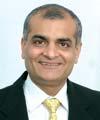
Success Story: Edelweiss Capital


Rashesh Shah is not your typical Gujarati businessman. He was among the first in his family to study in an English-medium school at a time when his elder cousins and siblings were in Gujarati-medium ones.
He didn't just step into his father's business -- manufacturing and selling school exercise notebooks -- as all good conservative Gujarati boys tend to. He went on to study higher and higher (he followed a BSc in statistics with a one-year diploma from the Indian Institute of Foreign Trade, and then a two-year MBA from IIM, Ahmedabad ), something very few hard-core Gujarati business families consider worthwhile.
Then, he decided to marry Vidya, a Kannadiga girl of his choice, at a time when marrying even a Gujarati outside your own small community was frowned upon. And if all that wasn't enough, Shah convinced his father to mortgage their Peddar Road house in the mid-1990s, to raise seed capital for his fledgling firm, Edelweiss, a step that's brazen enough to give many a conservative Gujarati nothing less than a coronary attack.

Rashesh Shah, Chairman, Edelweiss CapitalSomewhere in his knack of breaking the mould, Shah's father probably spotted the inherent fire in the belly of his then 33-year-old son and though his father is not here to see the fruits of what he backed, the 44-year-old chairman and managing director of Edelweiss Capital has more than lived up to his father's expectations.

Edelweiss Capital today is one of the few fully home-grown diversified financial services companies (broking is one of its business; 47 per cent of its revenue is from treasury and wholesale financing), competing for clients and employees with the Morgan Stanleys and Jardine Flemings of the world.

It's set a scorching pace of growth: its revenue in the first nine months this year is Rs 680 crore (Rs 6.8 billion), as compared to Rs 370 crore (Rs 3.7 billion) for the entire 2006-07.

It has a market capitalisation of Rs 5,500 crore (Rs 55 billion), an equity base of over Rs 2,000 crore (ten years ago, raising Rs 1 crore had been "quite a challenge"), 1,600 employees and over 40 offices all over India.
We are meeting at the Tea House of the August Moon , Taj Palace's long-surviving Chinese restaurant, where Shah has a lecture to deliver later that afternoon. We order two vegetarian soups, dimsums (a must-have at Tea House) and a vegetarian starter.

After passing out of IIM-A in 1989, Shah joined ICICI. "I had never wanted to be a businessman. I wanted to be a professional, wear a tie and suit, work in a corporate set up," he recalls. His ICICI job exposed him to the best in the business. "I dealt directly with the newly emerging  companies that were getting formed at the time -- Infosys, Bharat Forge, United Phosphorous, Mastek and their CEOs. I saw inspired people who were grabbing opportunities everyday," he adds.

It was also a key turning point in the economy. Then finance minister Manmohan Singh had started opening up India as never imagined before. The capital markets, thanks partly to Harshad Mehta, had started to boom. A host of high-quality entrepreneurs with new ideas were accessing them.

Shah and his former colleague and co-founder Venkat Ramaswamy kept toying with the idea of starting a home-grown financial services company, but Shah realised at some point -- after having lived through the coup in Uganda during a one-year assignment -- that "if I don't pull the trigger now, I never will." An avid tennis player, Shah quit in April 1995 (he was then with Prime Securities) to give Edelweiss -- an idea that had been growing in his head -- his best shot and his undivided time.

Fate, however, played tricks with Shah. Just when he took the final gutsy plunge, the market started climbing down (it went from a peak of 4,600 to 3,000), interest rates climbed up and the early impact of lowering duties began to show on industry. The Asian crisis made things worse. By the end of 1995, the state of the economy was looking bleak.

No one can be blamed but a few of the other proposed partners (all of whom were to bring in equity) got cold feet. He had no silver spoon in his mouth and savings, borrowings -- all they had -- were proving short. That's when Shah asked his father to mortgage their house at Peddar Road with Citibank to somehow touch the magical Rs 1 crore figure.

The tiny start-up (with just three employees) was operating out of a grubby office next to Akbarallys in Mumbai's Fountain area. "No one was willing to join us. We couldn't afford to pay much. We were unknown, had no history, very low capital. The odds were against us. The first three years (1996-98) were very bad," he says.

Personally too, it was a time when Shah was grappling with change; he lost his father and, in the process, his guidance and support and his responsibilities mounted with the birth of his first child.

Things began to look up a bit in 1998-2000 and by 2001, Edelweiss had grown to 11 employees. But things were to get worse before they got any better. 2001-03 was what Shah calls "the worst phase for Indian capital markets" (there was a massive drought in India, GDP growth fell to 3.5 per cent, 9/11 happened). "We hit real lows and I used to often think: when will this end?"

But what comes down must go up. 2003 proved to be a sort of take-off point for Shah and Venkat, and ever since, there's been no looking back. In the last four-and-a-half years, the firm has added 350 employees each year.

From a single sleek and gleaming new floor in Express Towers at Nariman Point in mid-2004, today it's spread to five floors and is threatening to slowly but surely take over the building. There are eight other offices at Nariman Point alone. Shah himself has moved from a 2,000 square feet leased flat to his own 3,000-square feet apartment in Worli.

What were his guiding principles and didn't he ever want to give up when the chips were down, I ask. Three golden pieces of advice from Infosys' chief mentor Narayan Murthy ring in Shah's ears even today ("he's had a deeper impact on us than even he may be aware of"). Do not give equity cheap, share benefits with your employees and attempt to build a high-quality organisation.

Shah says he's been very conservative with equity, except when it comes to his employees ("I think we have the maximum number of crorepatis as a percentage of employee base in India"), and that somewhere along the way, "organisation-building became an end in itself." The company compensates people with a combination of cash and equity (800 out of 1,600 own stock), so in bad times, costs are under control and in good times, you make hay while the market shines. "Hopefully, one day, it will be an institution," he adds.
Good advice is just one part of it. Hunger, says Shah, while picking doubtfully at his food. "We are hungry for growth. If the financial services industry has grown at 50-60 per cent for the last five years, Edelweiss has grown at 120 per cent every year for the last five years. One of our targets is to consistently beat the industry growth rate."

His colleagues say that Shah keeps a little yellow notepad on his desk, on which he meticulously lists and crosses out his priorities every day. I picture it saying, "Make sure you beat the industry hard today."
Faith helped too. "You can't have an India story without robust capital markets. So, we kept our faith in the bridge," referring to the capital market, "the bridge between the providers and users of capital." And giving up? He looks at me so blankly I'm sure he doesn't comprehend what that means.
Forget giving up, Shah is quite willing to go through the entire ordeal again if he had to. "I have played tennis for 18 years and I don't like social tennis. I play to win."

He may play to win but believes that luck too has its own role to play. "No matter what you may or may not do, you need to be at the right place at the right time," he says. He says he's been lucky to ride the "India wave" from 2003 and there's definitely been an element of good fortune.
As he finishes his coffee, we open our fortune cookies and I find Shah somehow has two messages in his, while I have only one in mine. Clearly, lady luck is shining on him, in more ways than one.

Source: rediff.com

From an Indian village to designing chips for the world


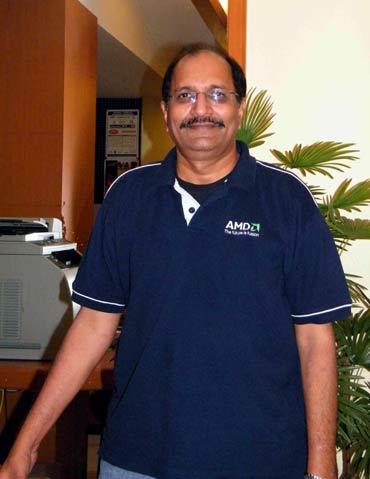
Dasaradha Gude, chairman of Soctronics and VEDA IIT.

The story of Dasaradha Gude, better known as 'GD', is almost like a fairytale.
He had his early education in an impoverished village but went on to do engineering in Kakinada. His life as an entrepreneur started the day he graduated from the engineering college.
Later on, unlike many engineers who go for higher studies, he went to the United States to work and make money so that he could start bigger enterprises of his own.
His working life in the field of semiconductors started there as a very basic job of a soldering technician making $4 an hour. Starting from there, he achieved a meteoric rise till he reached rarefied heights on the corporate ladder.
Having resigned from AMD as its global vice president, and also managing director for India recently, he has started his own company, Soctronics. It specialises in providing ASIC design services in both logic and physical design domains.
Currently he is the chairman of Soctronics and VEDA IIT, both based in India.
Here is the story of a serial entrepreneur who has started eight different companies so far!

You had your childhood in a remote village in Andhra Pradesh. How was it growing up in, like you say, an impoverished village?
Yes, I grew up in a small village called Machavaram in the Guntur district of Andhra Pradesh. My father was a farmer and the village chief.
We used to do dry farming like cotton, chillies, rice, etc. We were not rich but there was no scarcity of food. I used to work in the fields both in the morning and the evening.
There were no middle schools in my village, so after the 7th standard, we used to walk 5-6 km both in the mornings and evenings to the nearby village to study.
I was a good student but my dream was to be a good leader like my father was in the village.

Why did you then decide to go to Kakinada to study engineering?
I wanted to be the village head but my mother wanted me to study. Nobody from my village had ever gone to an engineering college.
There were only a handful of people who had even studied up to the 10th in my village. I was the first from my village to become an engineer.

You started your own company soon after your graduation. When did the idea to be an entrepreneur come to your mind?
Yes, I started my own company the day I graduated in April 1982. The idea to start a company was there in my mind when I was studying.
I thought, by starting a company of my own, I could give jobs to many people from my village.
We used to design lab equipments when we were students. So, the moment I graduated at 20, I started Amaravati Electronics with four of my classmates and we designed lab equipments. 
Then it so happened that a friend of mine who had started a mainframe computer business in Mumbai wanted me to help him.
That was the first time I was introduced to the world of computers. I had had no previous experience with them but somehow it worked. I enjoyed working on mainframe computers!

After that, you decided to move to the United States. Why?
The reasons why I wanted to go to the US were to earn money to start a bigger company and also to learn the technology, bring it to India and start a company with the know how. Many of my friends and relatives also were there in the US then.

I went to Los Angeles and started at a very basic level, doing soldering for computers! I got $4 an hour. The great thing about the US is that if you are good, you are appreciated. I was promoted every week.
In 6 months' time, I was running a division that had 200 people and earning $20 per hour! I used to run the division from 11 pm till morning. That is the spirit of that country.
I then decided to move to the Silicon Valley because what I was doing was not engineering. I tried to join a firm that designed chips.
They said, you are from an ordinary engineering college and we have only IITians and highly qualified engineers from noted universities in the US. They frankly said I didn't fit in there. However, they needed a helper in the reverse engineering of chip design. But that also, they were not at first ready to give me. My idea was to understand what exactly they were doing.
Anyway, I helped them extract the logic from the chip: that is reverse engineering!
What I did next was, I extracted the next chip for them, not as their employee but as an outsider. I gathered a few unemployed engineers and was able to deliver within a month and we made good money. Soon, the company employed all of us.

When was your dream of becoming an entrepreneur realised?
I wanted to start something that was technology-driven. Though I worked in the field of semiconductors, as a business it was a very expensive affair at that time.
But I had the know-how of semi conductors. I also understood that semiconductors were going to be the field where I was going to work thereafter.
I was working with Epson at that time. I then quit the job and started my own company -- Top Notch Electronics.
The chief executive of Epson also joined me. Within a short time, we sold it to another company. Then, we started Pacific Semiconductors that designed and manufactured chips in Taiwan.
The arrangement was that we would give the design to them and they manufacture it for us. The difference between ours and Epson's products was that ours were cheaper and customised for new areas.
I started the company based on deals with many companies and people and put together $5,000 to $10,000, and within a year, we were so successful that our revenue was $11 million.
The profit margin was 40%. Soon, our company was bought by Faraday.

What was the idea behind selling it then?
Six months after selling Pacific Semiconductors, I started Qualcore Logic with a couple of million dollars I got by selling the old one. So, right from day one, the company was profitable. We were into IP designing.
Yes, I came to India (Mumbai) to hire engineers here and trained them to do what I wanted. The idea was to write the design in verilog, a software language.
I moved Qualcore Logic from Mumbai to Hyderabad in 1997 and we were the only one in the field of IP design then. We exported our designs to all over the world, mainly to Japan, Taiwan, the US, and also to Europe.
In 1997, when you exported to other countries, how did they look at a product coming from India?
Things going from India didn't have a good image then. But we had an office in the US and we used that address for all our operations. Only design was done in India because it was cheaper to do it here.
We could manage to sell only because we had an office in the US. Now, the image has changed but in those days, it was different.

You chose to hire engineers from India at a time when outsourcing was not heard of...
Yes, in those days, outsourcing had not started on a large scale on IP design but I felt  it was the best way to run a company.
Our revenues were close to $10 million. Then, I sold it to Zylog Systems for $43 million.
Then I started Cute Solutions which did the software work for IP designing. It was taken over by AT&T Technologies and later on acquired by AMD.

You joined AMD then. What was your role there?
I was the Global Corporate VP and MD for India of AMD, I grew the team from 50 to 1,100. We developed the audio technology for Kodak, multimedia software for all the iPods and we were one of the top five in the world.
We developed both the chip and the software; the complete package. We sold it to cell phone customers like Motorola, LG and Panasonic. We also sell the designs, software and chips for TVs.
For example, Sony Bravia, etc are completely developed here in Hyderabad.

Can you name some of your successes in design?
One of our first successes was a single chip we developed for multimedia mobile phones like LG. We developed it faster and better than the US companies. After that, there were many more.

We became number one in graphics in the world. Last one was Ontario which is used in net books and tablets. It's a fusion chip developed by AMD design team in India. This chip includes both the CPU (Central Processing Unit) and the GPU (Graphics Processing Unit)
I came out of AMD and started Soctronics which is into semi conductors design and services, a systems and software company that does audio multimedia design for Japanese companies like Sony, Yamaha, AMD, etc.
I want to show Made in India by an Indian company and not Made in India by a US company.

As an entrepreneur, you create companies and then sell them. Why do you do so?
A serial entrepreneur should never get attached to what he creates. You should always be ready to go to the next stage.
And to go to the next level, you need more money which you can get only by selling whatever you create. When you can sell what you create, it shows the success of your product.

Source: rediff.com

The amazing success story of redBus

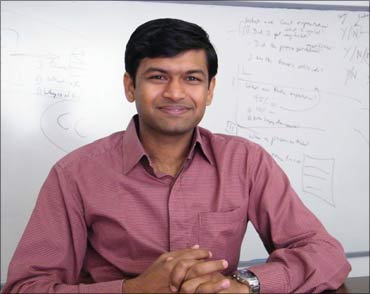
Phanindra Sama, CEO, redBus.in

Phanindra Sama, the chief executive officer of redBus.in, is yet another engineer who chucked his lucrative job to start an enterprise of his own.
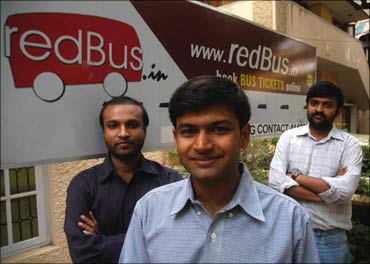
In fact, redBus.in was founded by three engineers -- Phanindra Sama, Charan Padmaraju and Sudhakar Pasupunuri -- who studied together at the BITS, Pilani, and later worked in various companies in Bengaluru.
Started modestly in August 2006 with a few seats from one bus operator, redBus today is one of the most successful online bus ticket booking agencies. Today, it has 700 bus operators, 10,000 buses listed on it, works in 15 states and sells around 5,000 tickets every day.
Last year Phanindra became the second entrepreneur from India to join Endeavor, a non-profit organisation started by the Harvard alumni.
In an interview with Rediff.com, Phanindra speaks about his journey from an engineer working for a company to an accidental entrepreneur

The redBus founders.
Was the bug to be an entrepreneur there when you were students itself?
None of us had this entrepreneurial bug earlier. My ambition was to be an electronics engineer and I was happy working for Texas Instruments in Bengaluru after passing out from BITS, Pilani.
The seed was sown when I couldn't get a bus ticket to go back to Hyderabad during the long Diwali weekend in 2005.
As I had no other work, I went to a bus ticket agent and asked how the whole process worked. I felt there might have been a bus which went vacant and he didn't know about it.
When he explained how bus ticket booking worked, I figured out that there were many inefficiencies in the system.


What were the inefficiencies you saw in the system?
Suppose there are hundreds of buses from 30 operators running from Bengaluru to Hyderabad, the agents do not have access to all the operators.
When an agent gets a customer, he calls a bus operator to find out whether there are tickets available. The operator looks at the chart and tells him the number of vacant seats.
The number of agents a bus operator can have is limited as he needs to identify all by phone. The agents also have only limited number of operators to work with. Then, the customers cannot always choose the seats as there is no transparency.
Another problem is, as the fares are not published, there is no fixed fare for the customer.
But the major problem was booking return tickets. Every time you went home, you had to call someone and ask them to book the return tickets from there.
At that time, travelling from Bengaluru to Hyderabad was like travelling between two countries.
Being an engineer, when you see a problem, you start thinking about solutions. I felt computers could solve these problems easily.


Did the idea of starting an enterprise on those lines occur to you then?
No, that was not in my mind at all at that time. It was like, there is a problem and it can be solved. That weekend itself, I wrote a mail to my room mates telling them about the problem, and why I had to stay back.
I also wrote, 'I see a solution to this problem and could we work on this?'
What I planned was, create a software, sell it to bus operators and give the money to some NGO. It was not a business proposition at all at that time.
When did the idea change to starting an enterprise?
It took a while.
At that time, it was very exciting for us to find a solution for such a problem that involved thousands of people.
In January, 2006, we -- the seven of us -- divided the work amongst us and started working on weekends on the project.
When the prototype was ready, we went to the bus operators and tried selling it to them, but they were not even willing to take it for free. It was like, we were trying to disturb the status quo. We didn't know what to do.
That was when we heard of TiE, Bengaluru, and we went to them with the business plan. They gave us three mentors to advise on what to do.


Were the mentors responsible for you starting the enterprise?
Yes, they gave us the idea to start a business of our own. They gave us assignments every week. It was like doing a market survey.
We were very prompt in doing all the assignments as we felt when such big businessmen were taking time out to help us, we also would be meticulous in our work.
By then, only three of us were left to do the work. As a result of working every weekend and collecting so much information, it became a business for us without even them telling us.
What was the information you had collected?
The number of buses, the number of routes, the average price of a ticket, how people buy tickets, the profile of customers, how much commission a bus operator pays to an agent, etc.
It may not be comprehensive, but it gave us a general idea of the industry. Even today, we continue to study the industry and we cannot stop.


From where did you gather capital for starting the company?
We started in August 2006 with Rs 500,000 which was the savings of the three of us. One room of the house where we stayed was our office. In the morning we would keep the other parts closed so that the room looked like an office.
By now, three more people who were young relatives of ours had joined us to help out.
How did you think of the name RedBus?
At that time, I was reading the autobiography of Richard Branson who started the Virgin brand. The way he rose up from poverty fascinated me. The Virgin brand is red in colour. Marketing becomes easier if you have a colour.
As we are an Internet-based company, people would have to type our name. So, it was better to have the easiest name. That was another reason we zeroed in  on red.
As we studied in BITS, Pilani, we used to go via Delhi and there, you have red line and white line buses. Though we first thought of redline, the name was booked. Then we decided on redBus.
Angeline, a friend of a classmate, designed the logo for us.  We registered redBus.in and created a web site.

Were you enjoying the challenges?
Life after we started redBus was very tough; from a pampered corporate life, we were thrown into a life of uncertainties where we had to go to people requesting for things.
To the bus operators, we were like the hundreds of sales people who went there. The world of business is totally different from the world you see as an employee. What we faced were huge challenges.

How did you let the customers know that they could book on your web site?

We used to go to the IT companies, stand outside when the employees came out for lunch and then we gave our redBus cards. For the first time, we were on the other side of the fence.
A few weeks back, we were inside a campus and we used to ignore such sales people or brush them aside. Now, we had to kill our egos. It was a big moment of truth for us.
In entrepreneurial life, you have many such humbling experiences.

How was the first day when you opened your web site for booking?
That is another story. After several visits and many requests, one operator agreed to give us five seats. It was on the August 18. He said, if you sell 5 seats in one week, its fine. If you don't, don't bother me again. We had one week to prove ourselves.
We put the seats up! We told all our friends and colleagues and asked them to buy from us. We also requested one of our friends to write about us on their discussion board at Infosys.
On the 22nd of August, we sold our first seat. A lady working at Infosys booked a ticket to go to Tirupati. We were so tense that we went to the bus station and waited till she boarded the bus. We didn't tell her that we were from redBus.
We sold all the seats in five days and went back to him. Slowly, we could add more operators to our inventory.

When did you scale up your operations?
When TiE selected ours as one of the three ideas out of 300 for mentoring, it became news. It was followed by venture capitalists contacting us as they found our idea interesting.
Before we went to TiE, we didn't know anything about VCs (venture capitalists)! That was the time there were many VCs and very few ideas. So, people were willing to put up money for our idea.
We asked our mentors and they told us to take the money and begin developing the idea.
The VCs asked us how much money we needed, we said Rs 30 lakh (Rs 3 million) as that was a big amount for us then.
Then one of the VCs spent several hours with us and we revised the plan seven times. At last, we found that we needed Rs 3 crore (Rs 30 milion) to scale up the business. The agreement was that money would be invested in three years.
That was in February 2007 and the money was supposed to last till February 2010. We spent all the Rs 3 crore in one-and-a-half years.
The VCs also asked us to change from an online bus ticketing company to just bus ticketing company, and that is what redBus is now.
Once you take money from someone, it becomes a business and you have to return profits on that money.

You started operations in August 2006. How did the first year go and also the subsequent years?
The first year was not a full year and we did Rs 50 lakh (Rs 5 million) worth of business in the first financial year. There were no profits.
Second year -- the year ending 2008 March -- was a huge success. The turnover was Rs 5 crore (Rs 50 million). We had 25-30 people working for us in three offices and had 50 bus operators.
In 2009, we grew six times and the turnover was Rs 30 crore (Rs 300 million). In 2010 March, we had Rs 60 crore (Rs 600 million) as turnover. We hope to do Rs 150 crore (Rs 1.50 billion) this year.
Today, we have 250 people working for us in 10 offices -- Bengaluru, Hyderabad, Chennai, Coimbatore, Pune, Delhi, Vizag, Ahmedabad, Mumbai and Vijayawada. This covers all the places where the bus industry is active. Southern India is most vibrant on the Internet and then comes western India.
We have seven physical call centres and three satellite call centres and tickets are home delivered in 10 places.
We sell more than 5,000 tickets every day. We have 700 bus operators with us. And we have only touched the tip of the iceberg.
There are 5 lakh (500,000) tickets with us to be sold every day and we sell only 5,000. So, there is a lot to grow. It is a Rs 15,000 crore (Rs 150 billion) industry and we are a small dot in the business.
We are profitable from December 2009. In the next four years, we plan to cross Rs 1,000 crore (Rs 10 billion).


How did your association with Endeavour start? You are only the second Indian to be a part of this international network?
Endeavor is a non-profit organisation started by the Harvard alumni. They identify high impact entrepreneurs and provide them help in scaling up their businesses.
In India we were selected because of the revolution we brought in the bus transportation industry in India. They helped us connect to potential joint venture opportunities in Uruguay, Argentina and Europe.
They also provided us the opportunity to take Harvard MBA students for internship, which was otherwise highly impossible for a company like ours to even think of. Besides this, they also connected us to some of the very famous personalities in India who helped us in scaling up our business.
How has the journey been so far?
The journey so far has been amazing and an eye-opener as an entrepreneur and also as a human being. Every day is a learning experience for an entrepreneur.

Source: rediff.com

From Rs 40K to Rs 1,866 cr: Success story of Luminous' Malhotra

 
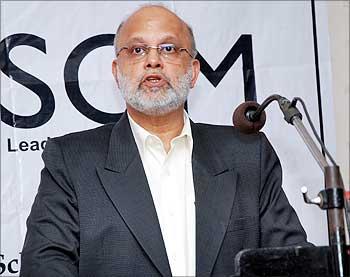
Rakesh Malhotra started to build a business in 1988.

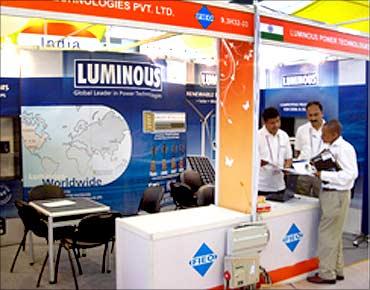
When Rakesh Malhotra started to build a business for himself in 1988, he had five years of work experience, all of Rs. 40,000 in savings and an engineering degree. Over the years, he built a brand called Luminous that first came out with power back-ups for computers and then invertors for homes in 1994.
Now, it is also into other businesses like telecommunication infrastructure, knowledge process outsourcing and renewable energy.
It took a good 18 years for Luminous Power Technologies to make its first Rs. 100 crore (Rs. 1 billion), but in the next five years its turnover shot past Rs 1,100 crore (Rs. 11 billion).


Schneider Electric has bought 74 per cent stake in Luminous.
Earlier this week, the $20-billion French engineering major, Schneider Electric, announced the acquisition of a 74 per cent stake in the company, in a deal that values Luminous at around Rs 1,866 crore (Rs. 18.66 billion). The son of a civil servant, Malhotra grew up in Delhi and Punjab, and studied at Delhi Cantonment's Kendriya Vidyalaya for the most part.
'Business' was not something that he inherited. After securing an engineering degree in electronics and telecommunication from Jadavpur University in West Bengal, he joined the Tata group's Nelco in 1983.


Timing, luck and dedication worked for Malhotra.
He later worked with Mitsui and Siemens but by 1988, when Malhotra had turned 26, he had developed a strong urge to turn entrepreneur.
"One wanted to create something but felt limited by the profession's set-up," he says.
Three things worked for him - good timing, luck and dedication.
Along the way, Malhotra's childhood associates Navnit Kapoor and Sunil Bhalla joined him as co-promoters.
Soon came in private equity investors and the financial institutions. CLSA Capital put in some Rs. 83 crore (Rs. 830 million) in 2007, and in four years, Schneider has made an entry.


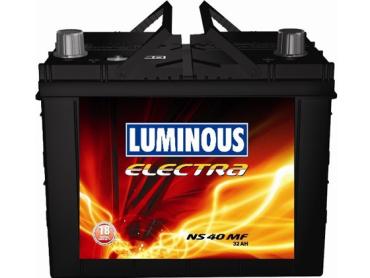
Luminous makes invertors.
"Some PE investors did carry out due diligence of the company but we wanted a partner with similar values and common areas of technology that can complement our brand and give us a geographical advantage," he says. Schneider's coming will also bring in best practices.
Though Malhotra, chairman and chief executive officer, says that the company's operations will remain independent, the focus will be to build from where it is today.
"It is a well-structured organisation with a professional workforce. I was on the back seat already," he says.
Retirement, however, is not on the horizon.
"We (promoters) are in our forties and have a lot to do."


Malhotra's father leveraged his life savings for his son's loans.
He plans to enter the space which just precedes the entry of private equity players - a stage of incubation for companies that are small but have a strong management and are in the field of technology. In the true spirit of entrepreneurship, Malhotra says he wants to be in a place where things are getting created.
Creating a business, incubating it, and then cashing in on the value created seems to be the way modern entrepreneurs are working.
"In older times, people were confused about management and ownership but now change in shareholding does not impact continuity of management."
Indian businesses are maturing to a level where management is not governed by the shareholding, he says.
For Malhotra, whose father did not want him to become a businessman yet allowed his life's savings to be leveraged for his (the son's) loans, it is innovation time again.

Source: rediff.com

A 'green' entrepreneur's success story


Pramod Chaudhari, Executive Chairman, Praj Industries.

It has been 25 years of entrepreneurship for Pramod Chaudhari. A successful entrepreneur, he describes his experience as an exciting journey full of ups and downs. After his engineering from the Indian Institute of Technology Bombay, Pramod Chaudhari worked for a multinational company for a few years. Later, he decided to start his own venture. Passionate about green technologies, he established Praj Industries in 1984.
It was not an easy ride. He failed many times but that did not deter him from taking new initiatives and moving ahead. His never-say-die attitude and optimism made sure he built a world-renowned company. Under his leadership, Praj focusses on offering innovative solutions to add value in bio-ethanol, bio-diesel, brewery plants and process equipment and systems for customers worldwide.
Praj has been creating innovative technology platforms to make biofuels a sustainable choice toward making a greener planet.
Praj was recently conferred the 'Forbes Best Under a Billion Company' in Asia, for the second consecutive year, based on  its consistent growth and profitability over three years.
Chaudhari has also contributed to the National Biofuels Policy as a member of the Committee on Development of Biofuels, Planning Commission for introduction of renewable fuels to India.
He believes that innovation and entrepreneurship must go hand in hand to build sustainable solutions. Stressing the importance of intrapreneurships, he says, young managers within a company, who have good skills and ideas must be encouraged to develop their ideas. Chaudhari shares his views on entrepreneurship and his company's initiatives to promote green technology.

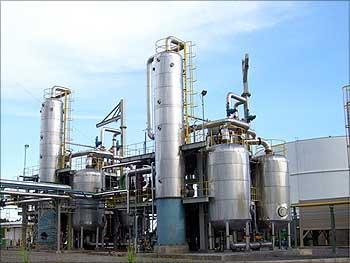
Praj's fuel ethanol plant.
 
How difficult was it to leave a good job and start a venture on your own?

It was very difficult as I was working for a MNC. But my father had confidence that I will do something different. I told them that I will give it a try for about five years and I won't be a burden to them.

What are the core activities of Praj?

Our core business is to offer technology design and machinery for the production of bio fuels.  We try to bring in green technology in our day-to-day activities, like green design, green manufacturing, energy efficient technologies and waste water treatment.
We operate on five parameters. Our products facilitate the use of bio fuels, our processes are green as they consumes less water and less energy. In all our processes we keep a tab on low energy consumption, lesser paper use. We also encourage our employees to take part in social activities related to the environment. So we complete the pentagon of green initiatives.

What is the market potential for biofuels?

It is a regulated market. The government has allowed 5 per cent blending of ethanol in fuel. There is a road map for 10 years so that will develop the market for bio fuels.  There is a long way to go.
Praj offers technology, plants, and services for biodiesel production. Praj also offers a biofuels complex wherein one can produce both bioethanol and biodiesel. We do this business all over the world. We have our operations on all the five continents. We can make biofuels from different raw materials in a cost-effective manner. We are doing a lot of research in developing bio-commodities. Bio-commodities are biochemicals, which can be made from agricultural waste.
Hydrocarbon and carbohydrate products will co-exist. Hydrocarbon is a depleting resource and is adding more carbon dioxide to the environment. It will dry up one day whereas plants are a renewable resource.
 
What kind of challenges do you face?

It is a big challenge to make these products cost effective and commercially viable.

How do you see India's role in green technology area?

It is a new avenue. Thirty years ago, India was trailing by 20 years in terms of green technology initiatives. Today, we are almost close to the Western world. Thanks to the liberalisation that started in the 1990's, we are able to catch up with the West on many fronts, IT was the first.
We got the full benefit of IT and now it is stabilising. We are in the forefront of bio technology and green technology now. We have good talent in India so in terms of clean technology we are at par with the world.

Is there lot of market for start-ups in the clean technology area?

The market is huge. For new entrants, there is a document called NAPCC (National Action Plan for Climate Change), released by the Prime Minister Manmohan Singh last year.  It lists ten missions like solar, water, etc. . . so each mission offers huge opportunity. The biggest will be solar projects. The outlay for solar mission will be announced on November 14.
 
Do you face a talent, manpower shortage?

We do not face any shortage. There is a huge talent available in tier-2 cities in Maharashtra and in other parts of the country.

You talked about intrapreneurs? How do you plan to encourage intrapreneurship?

We encourage our own employees to come up with ideas, take risks, be responsible to the bottomline. It could be a new design, new business model, etc. I feel this generation is very lucky as there is a lot of support. There are lot of government agencies and financial institutions to support them.
When I started there was hardly anything. So it depends on the risk-taking ability of entrepreneurs. So they should become intrapreneurs as there is a safety net in an organisation. So intrapreneurship is not a bad idea. It's not inferior to entrepreneurship. They may be as good as entrepreneurs.
The innovative contribution of entrepreneurs is supported by intrapreneurs to make a successful organisation.
Praj has launched the 'Maha-Intrapreneur Award' to recognise the efforts of intrapreneurs.
 
There is too much focus on services than product development in India. What are your views?

Service is not a bad idea. It requires lesser capital. The growth prospects, however, will be limited in terms of services. Service is good to create more employment.
For instance, if an entrepreneur wants to expand business in another place he must find an entrepreneur there and make him expand business, that way more people get involved without hiking his overhead costs.
To develop products, you need a lot of capital. But there are agencies and venture capitalists that can help you with he capital as well. However, making a product or a prototype takes a long time or you need a lot of patience.
There is a gap in the funding for many start-ups as angel funding dries up and VCs find it small-ticket business. So many technologies don't see the light of the day. The gap between angel funding and VCs needs to be bridged.

What do you think about talented Indians going abroad to work?

This is changing now. During my college days, it used to be so. About 80 per cent of my classmates went abroad. But now reverse brain drain is taking place. There is a herd mentality here, if your neighbour is rich, has a car, etc, then you too must be at par with him. . . .

What are the reasons for your success?

I really don't know. I don't have a recipe for success. I believe that one has to be very lucky and be at the right place at the right time. You have to go on trying, put in a lot of effort till Lady Luck smiles at you. I have hit the bottom twice but my optimism helped me survive.

What would be your advice to entrepreneurs?

The decision to become an entrepreneur itself is a great achievement. Creating value for whatever product or service is good. However, the focus must be to offer a solution for the society, solutions to make this planet a better place.

Source: rediff.com

From Jalgaon to Harvard: A farmer's success story


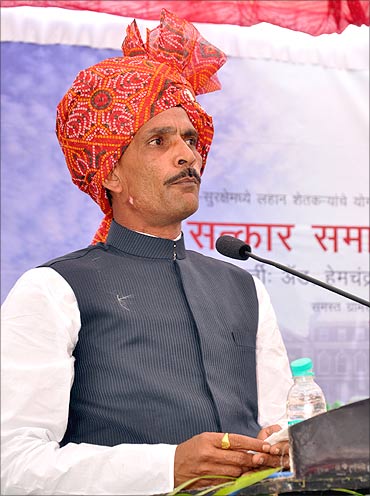
Hemchandra Dagaji Patil (L) with Rajendra Hari Patil (R).

In a state that tops in the number of farmer suicides across the country, the success story of two farmers from Jalgoan is a shining example of how technology and innovative cultivation methods can transform the agrarian economy and uplift the lives of millions of farmers.
In this two part series, we take you through the success stories of two farmers.
Job loss, financial problems and meagre income from a small farm is history for Rajendra Hari Patil, who now earns Rs 25 lakh annually.
It has been an incredible journey for Rajendra Hari Patil and Hemchandra Dagaji Patil who traveled from Jalgaon to the Harvard Business School to talk about their success.


Rajendra Hari Patil.
Suraj nikaltehi roshni dethi hai
Phool khilte hi khusboo dethi hai
Zindagi may kuch karne ka tamana hai agar dil may
Zameen to kya aasman bhi saath dethi hai

Rajendra Hari Patil is reminded of this inspiring couplet before he walks to his vibrant fields every day. The vast expanse of greenery is his inspiration to live and work hard.
A high school teacher-turned farmer, Rajendra's life has been full of uncertainties since childhood. His father, a farmer, passed away when he was very young. He along with 6 brothers worked hard in the fields to manage the house and earn enough money for their education. "It was a tough life but the struggle itself was a learning experience. My mother took lot of trouble to raise us. So we became very independent," says Rajendra. All of them eventually turned out to be school teachers.

Difficult times
As a teacher, he has a respectful job in the village. He got married to a teacher as well. But destiny willed otherwise.
The biggest blow came when he lost his job. There was nothing he could bank on except the 1.5 acres of family property.
"I decided to try my luck with farming as it was difficult for me to get another job. Everyone including my wife were disappointed. I started going to the fields but I realised that with such a small area, he could hardly earn any money. I took 6 acres on lease as well," reminisces Rajendra.
Without money, it became difficult for him to manage even the household expenses.


Technology turns saviour
As every other farmer in the region, he also practiced traditional farming till he saw some success stories of farmers on television.
They had adopted newer methods of farming like drip irrigation and tissue culture.
In 2006 he approached Jain Irrigation, a company that manufactures drip and sprinkler irrigation systems and components.
Besides supplying drip irrigation equipment, the company also helped him with seeds, tissue cultured plants, micro-irrigation systems and advice from agronomists.
"Rajendra and Hemachandra are just representatives of thousands of successful farmers who have taken up newer technologies and drip irrigation. In India, Maharastra has the maximum number of farmers adopting drip irrigation. Now, there is more demand from farmers in Andhra Pradesh, Gujarat, Karnataka and Tamil Nadu also," says Dilip Kulkarni, president Agro Foods, Jain Irrigation.


A great beginning
It was a turning point in his life. "I started off with 10,000 tissue culture saplings of bananas in 2006. I got a good harvest after 10 months. In 2007, I planted 18,000 saplings.
The total investment per plant is Rs 55.
The yield was truly God's gift for me. We got a yield of 28 kilogram per plant. Eleven trucks were hired to carry the harvest to the market. On the way, we got down and sought the blessings from Bhavarlal Jain, founder of Jain Irrigation. 
"In 3 years time, I took 60 acres of land on lease and cultivated 5 lakh saplings. While in traditional farming the loss is up to 35 per cent, with tissue culture the loss is just 5 per cent. We get Rs 25 per kilo per plant," says Rajendra.

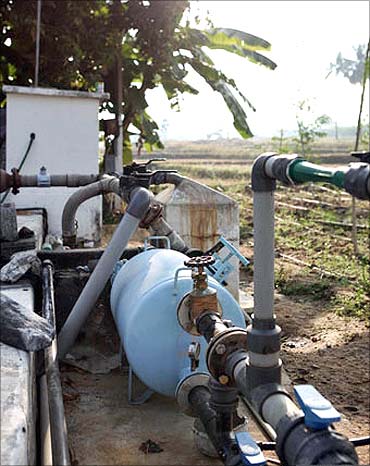
Pump used to supply through drip.
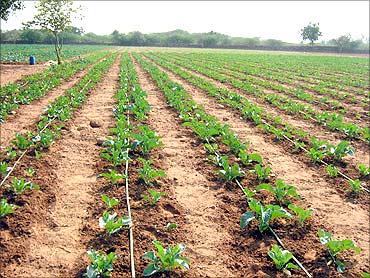
Besides banana, the farm also cultivates wheat, ginger and sunflower. He owns 7 acres of land now, besides 60 acres taken on lease. The production has gone up by 60-65 per cent. Out of the total irrigated area in India, only 2 per cent is under drip irrigation.
"Many farmers in northern states have plenty of water. They have a misconception that drip irrigation is not useful. We have found the crop yield rise by 2 to 3 times in every state," Dilip Kulkarni explains.
The cost of installing the equipment could vary from Rs 15,000 to Rs 40,000 per acre. While the government offers a 50 per cent subsidy, not all small farmers can afford to install the drip irrigation system.


Reaping profits
The banana yield rose to 40-45 metric tonnes per acre from 22-24 metric tonnes per acres.
The profits were encouraging as it rose to 3-fold. Rajendra now earns Rs 25 lakh annually. Rajendra leads a better life today.
He commands lots of respect. He no longer worries about losing the teacher's job. "I would have never tried my luck with farming if I had not lost my job. I do no regret it anymore. This job gives me a lot of satisfaction," says Rajendra.
Rajendra's path to success has not been easy.


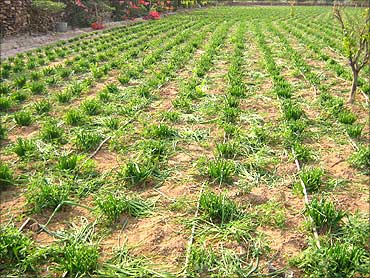
Drip irrigation in a Chilli field.

Daily routine
His day starts at 7 am. He drives to the field twenty kilometers away daily. He is at the fields till 9 almost every day.
"The field never tells you what to do. Even 24 hours is less for a farmer like me," says Rajendra. Besides working hard himself, he also has to monitor the work of the labourers.
"It is difficult to get good workers. They do not come for work everyday. The government offer rice for Rs 2 per kg so why should people work hard. The worker takes things so easily," says Rajendra.


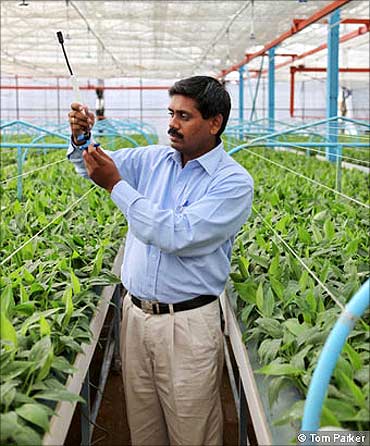
An agronomist examining banana tissue culture plant in Jain Green House.
Climate change hits yield
A farmer can never be sure of the final yield as climate is a major factor for a good crop yield.
"The ideal temperature should not vary beyond 16-44 degree celcius for tissue cultured crops but this time temperature has risen up to 47 degree celsius. Our production will be affected as the temperature has not been stable. When the production is less, the price is high and vice versa so a farmer doesn't benefit much from the price rise," he says.


'God is the only hope for farmers'
"It is a tough life for farmers in India. God is the only hope for farmers. In Jalgoan, out of the 120 hectares of land, only 25 hectares have got a subsidy for agriculture. Unless, government and banks helps the farmers with timely loans, how can we progress," asks Rajendra.
Recently, the government of Maharashtra felicitated him with Udyan Pandit Award-2010 for his success. He also won the 'Dr Punjabrao Deshmukh Krishi Ratna Puraskar' in 2009 from Bharat Krushak Samaj, New Delhi.
 "I feel this kind of awards should be stopped. There is no respect for farmers in India. What is the purpose of such awards when they cannot help us when we are in need. Farmers should instead have a say in policy making," Rajendra explains.

A new life
"My life has changed quite a bit. I have a great respect. People from far off places call me to their fields to guide them. But I still live in a rented place," Rajendra says.
He is happy that he has enough to keep his family happy. His children go to English-medium schools.
His son is in the 8th standard while daughter is in the 5th. "I always tell them to value a farmer's money and hope they can do something good for the farmers and agriculture," he says.
The journey doesn't end with this success. Rajendra feels he has miles to go. "My earning is ploughed back into the farms. I feel the farms need it the most. Being educated helps as he knows more about plants, fertilizers and the technologies that can be used," he says.


The Harvard experience

The first flight he took was to America. Jain Irrigation had organised a trip for two farmers from Jalgoan to go to Harvard Business School for a presentation.
"It was a great experience.  I had never imagined that I would travel to America and meet so many eminent people.
Professors there asked tough questions like, 'Why are there so many farmer suicide if you have the latest technologies'.  He says one cannot compare an Indian farmer with an American. A person with 4 acres of land is considered a small farmer in India whereas in America a person with 4000 acres is a small farmer," he observes.
Rajendra was impressed to see how America practices mechanised farming successfully. He was envious of farmers who did not face problems to avail loans and financial assistance for farming.


Drip irrigation in an onion field.
Future plans

"Our farmers still struggle to get money on time so it affects the farming cycle. Many of them end their lives unable to bear the pressures of farming," Rajendra says.
He hopes the government takes more interest in helping farmers as thousands of farmers live in penury. On his own initative, Rajendra tries to reach out to as many small farmers and guides them.
He plans to join hands with other farmers, take 50 acres of dry land on lease and turn it into one of the best farms.
"It is a big dream which will take an investment of Rs 3 crore (Rs 30 million). I can invest about 20 per cent of this and hope I will be able to get loans to make this a reality," says Rajendra. The land will then be used as a demonstration field. "I will train and guide other farmers free of cost. I wish to see many more success stories in the agriculture sector," says a confident Rajendra.

Source: rediff.com

Story of a top Indian entrepreneur

 
Sunil Maheshwari.

Sunil Maheswari, the chief executive officer and co-founder of Mango Technologies Pvt Ltd, has many accomplishments to his credit. MINT-Wall Street Journal described Mango Technologies as one of the 'Top Ten Startup Companies of 2008'.
In 2007, he won the top innovation award from Nasscom and recently, Business World named him one of the top five entrepreneurs in India. Sunil had managed the team that designed the first 'Designed in India' mobile set and the world's first dual SIM phone.
Mango Technologies is a software solution provider for all low and medium segment mobile phones.
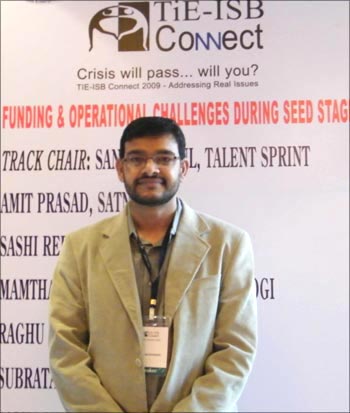
At the 'Jumpstart Your Venture' workshop of the recently concluded TiE-ISB Connect 2009, Sunil Maheswari spoke of starting up a venture. Rediff.com caught up with him after the presentation, and here is his story.


Desire to be an entrepreneur
I had the desire to be an entrepreneur very early; when I was in college itself. I started dreaming about what I should do after my studies. I was influenced by the stories of all the entrepreneurs in India right from the Tatas and the Birlas.
I took the first risk in my career by quitting my job at Reliance Infocom to join a startup company. That was when I saw entrepreneurship up close. I was the second person to join the company. That was where my close encounter with entrepreneurship started. I was doing many things there, including all the nitty-gritties.
We designed a complete mobile handset and that was the first 'Designed in India' handset. It was also the first dual SIM phone. It was a proud moment for us when we could show the phone to the then President Dr APJ Abdul Kalam.

The idea germinates
The year was 2006. It was the right time for an engineer as the market was up and we were getting fancy salaries. It took only one or two months for me to take the decision that I was going to start an enterprise of my own. My family -- my wife -- was very supportive and my friend Lekh Joshi also was supportive. So, we did not face any kind of hurdle.
I come from Rajasthan where there are a lot of entrepreneurs. So we did not look at starting an enterprise as a risk.
We also did some market analysis and found that even if we failed, there would be other opportunities. But we were sure of one thing; we did not want to lose time.
I and Lekh Joshi sat and discussed product ideas, products and what we wanted to do. Probably it was the mango season! We decided to name our product Mango! It did not take us long to reach the name. And the company name came from there.
We also wanted an identity and we thought the word Mango reminded us of something that we consume quite often.
As both I and Lekh worked in the mobile phone domain, we knew that our product also would be in that area.

Starting an enterprise
We started Mango Technologies in Bangalore with less than Rs 10 lakh (Rs 1 million). We were lucky in the sense that we started our operation from our house. A friend who was running a company had some unused area with PCs and we started working from there by giving a small equity to him.
We didn't have any operational expense then as first we operated from my home, and then from my friend's place.
We hired two people. We started building a complete operating system for mobiles. We had a good understanding of the market and some of our potential customers. So we knew where we are going to work and who we are going to target.

The mobile market
By 2006, the mobile market had already started to boom. We saw a healthy demand not only in India but in the other emerging markets also. That's when we decided that emerging markets needed a different kind of software, not just what you get from China, Korea, etc.
The requirement in India is different from the requirements of China, Japan or the United States.
Indians are cost-conscious consumers. In the US, $300 or $400 phones are very common and operators subsidise and give them to consumers, but in India, that is next to impossible.
So we are very cost-conscious but we want the best: best devices, best services, best user experience. We are okay spending money in parts. Even the autowallahs are ready to spend Rs.5 for value-added services like downloading a ringtone but not okay in spending Rs 5,000 for a handset. It is a constraint. So for all device makers, it was a big challenge to make a set suitable for this kind of market.

First customers
We started partnering with Texas Instruments first and then we started working with Qualcomm and they are our number one customer, and they command about 20-25% of the world market in mobiles.
They are the number one mobile semi-conductor company and we are shipping with them. We have many language supports so that they can customise for various countries.
Awards
We won Nasscom's most innovative company award in 2007-08. Mint and Wall Street Journal wrote our company as part of the top ten startup companies of 2008, and recently, we were in the top ten innovators list published by Business World. All these awards really boosted our confidence. It helps attract good talent also.

Journey so far
Nothing is easy in life. With support from our families and the initial set of employees, our journey so far has been not that bad; in fact, it has been quite satisfying.
I believe that any time is the right time and every place is the right place. Even in the worst times, people have started successful companies. I don't think any time is wrong time.
I feel you can create your own niche any time and you need to change your plans as per what you see for future.
We are generating profits and investing them back in the company. Starting with the two of us, we now have 35 full-time employees. We have two offices now; one in Bangalore and another in Jaipur.
The journey is still continuing.

Future plans
We want to become world's number one mobile platform company in this segment which is the bottom 50% segment. We want to be in as many handsets as possible and give better service to our consumers.
Qualcomm takes us to many more customers but in the next step, when our software is available in millions of handsets, we want to directly work with end consumers and the developer community.
You need to create more jobs and more wealth in this country and the only way to grow is through entrepreneurs. If you look at all the successful economies, you will see that wealth is created by first time entrepreneurs. In India, Infosys, Wipro, Reliance are the best examples.

Source: rediff.com