Showing posts with label rags to riches. Show all posts

Wednesday, April 3, 2013

Ex-dishwasher now a multi-millionaire

Nothing in this life is easy.

This is wisdom that former dishwasher Larry Cortez would like to impart to his children.
Cortez left his hometown in Nueva Ecija in 1987 to try his luck in Manila.

Moving from one job to another, Cortez almost lost hope of finding success in the city.
“Nabura na ang pangarap ko na umasenso e. Ang nangyari nalang, basta makaraos. Ayoko maging pabigat sa pamilya,” he said.


Cortez started as a household help, became a security guard, and eventually found his way to the food and service industry by becoming a dishwasher.

As a dishwasher, Cortez never stopped dreaming big.

“Naging sakit na nating Pilipino, nangangarap ng maliit. Kapag nakuha mo ang pangarap mong maliit, minsan hindi mo na gusto, kaya nilalakihan ko na,” said Cortez.
His next job as a waiter paved the way for him to become a restaurant manager.
Through hard work, Cortez defeated all odds and is now the proud owner of 10 restaurants.
Despite his success, Cortez stressed that nothing in this life should be taken for granted.
“Gusto ko matutunan [ng mga anak ko] ‘yung value ng buhay. Walang easy life. Hindi napupulot lang ang success, pinaghihirapan ‘yan,” Cortez said.
“Mas mabuti pala kung ipinanganak ka ng mahirap kasi wala ka nang choice kung hindi umangat,” he added.

Source: www.abs-cbnnews.com

Rags to riches tale of self-made millionaire


He was a foster child from a notorious estate who became a hard-working but angry young man. Now, self-made millionaire Chek Whyte, who lives in 18th-Century mansion Bunny Hall, credits finding God as the bedrock of his success and mellower character at 45. JO ROBERTS found out more.

HIS nickname is Marmite because people either love him or they hate him.

But what does Chek Whyte care? The self-made millionaire's property and development empire goes from strength to strength despite the times, and he neither loses sleep over popularity nor listens to rumours – even the flattering whisper that he's one of the richest men in England.
"Yeah well, I just disregard it. I don't even mention things like that. I'm just a normal working class person, y'know; gets up every day, works a 12-hour shift, seven days a week. A lot of people try to tell you how much they're worth and all the rest of it, but it's not me," said Chek emphatically.

What about his description as one of the country's most successful property developers? "It's a source of pride but where people get the information from I never know. I suppose everything we've done, we've succeeded at and we've diversified, but do the people who write these stories really know what that means? I'm sure there are a lot of people out there better than I am. But, yeah, it's nice because people write that and think you're somebody," said the married father-of-three.
It's a surprisingly modest millionaire who supposes "there are a lot of people out there better than I am."

But then Chek Whyte is disarmingly open, and has none of the ego you might expect, insisting again in his broad Ilkeston accent: "I'm sure there are – I'm just a nobody type thing, I get up in the morning and go to work. We're just mooching along, doing a few bits, and playing about and enjoying us-selves."

Hardly! He has built up from nothing a hugely successful business that now involves construction, development, lettings, and specialist restoration of dilapidated listed buildings to their former glory. Chek has been responsible for renovating Bunny Hall, Clifton Hall, Colwick Hall, and has almost finished a stunning transformation job on Stanford Hall, the breath-taking HQ of Chek Whyte Industries, which will open as an auction house on March 19. There are also plans in the offing to build a £60m retirement village in the grounds.

Not bad at all for a son of the notorious Cotmanhay Farm estate, where Chek was one of five children whose parents enjoyed drinking and, in his mother's case, suffered from mental health problems. Subsequently, the troubled couple temporarily lost their children to Social Services on eight or nine occasions. Yet Chek insists he has largely good memories of his childhood years in Beresford Drive on the estate.

"I looked after everyone else," he said of his younger siblings. "It was hard but happy in some ways. You saw quite a lot of life on that estate, but it seemed all good as a kid. Mum and Dad would be there, but drunk."

Could Chek's taste for immaculate and extravagant surroundings be a reaction to chaos and deprivation of his early home life? "It's got to be," he concedes. "Everything has got to be clean. But in those days, if a shiny car pulled up, you knew Social Services were coming to take you away."
Despite the complex feelings that must lie beneath, Chek is matter-of-fact about his childhood.

"We were taken to foster homes in Nottinghamshire, Derbyshire and Leicestershire. We always got thrown out because I would fight with the foster carers' kids. Sometimes we'd get split up and other times they'd place us in twos. We were fostered eight or nine times."
Sadly, some of the carers Chek encountered did not provide the loving home-from-home a child in his position needed.

"There were some people in the foster environment who were there for the money. They didn't treat you kindly. The worst one, the one that scarred me, was when we had lice. One foster carer – a woman from Derby – tipped lice powder all over me in full view of the kitchen window, in front of the other kids outside who were all laughing. I was 11 and I was teased mercilessly.
"We were given salad cream sandwiches while the family ate steak, yet they were paid to feed us."
During the periods at home, things may have been difficult but relationships were still affectionate.
"I was close to my dad," said Chek. "He was brilliant. He spent a lot of time in the pub and he was a comical man. We were all close."

Chek left the frequently troubled but not always unhappy family home in Beresford Drive at 15.
"Mum kicked me out. I'd started work a year earlier to buy my own clothes – I was very particular about them. But that particular night, it was my brother's girlfriend's party..."
Chek's favourite clothes had been washed but they were still wet so he was forced to wear clothes he wasn't comfortable in. His reaction?

"I smashed the house up because I had a tantrum."
It wasn't the only time his temper caused problems; Chek was expelled from Bennerley School in Ilkeston the same year for hitting a teacher.
"I was expelled and started working at a car spraying place for a bit of cash," he said.
The young Chek had seen a lot of hardship in his short life and was already older than his years, so perhaps it's not surprising that he quickly became adept at fending for himself, getting his own flat in St Mary's Street, Ilkeston.

"At 16 I was on a YTS scheme as an asphalter for £23.50 a week. Rent alone was £17, so as well as my full-time YTS scheme, I had to work nights to afford gas, electric and food. I was working around the clock to survive."
In the following years, Chek's mum also moved out of the family home alone, and died some time later when Chek was about 25.
Chek remained close to his dad until he died about ten years ago.
Meanwhile, independent Chek was working long hours as a groundworker and asphalter and building up his own businesses, although there were several false starts.

"Aged 22, I launched my own business as a groundworker. There were difficulties I had to overcome – I was dyslexic, colour blind, I could hardly read or write. Yet in the early stages, I went from starting out to employing 300 staff within 18 months."
But the company Chek was working for didn't pay him – "that sent me bankrupt." It wasn't the last bankruptcy. "Again, another person didn't pay us."
But Chek was not a quitter.

"I still don't know how I gained the entrepreneurial mindset! The long hours I'd always put in had become my work ethic. Why only do 37 hours a week? That only gives you a normal lifestyle. The other 20 give you your car, a good lifestyle, and a better school for the kids. I started in construction, then became a builder, then became a developer – buying up, improving and selling on – and also moved into property rental.

"Now I've got good accountants, lawyers and surveyors because I can afford to. Back then I couldn't – it was a chicken and egg situation."
But the factor Chek really credits as the bedrock of his current success is surprising.
"Things really changed about six years ago when I met God and became a Christian. I built Trent Vineyard church's building in Lenton Lane and that's when my charitable side came out. I do a lot with them now. Meeting God makes you a better person."

Ideas man

In a mellower mindset, Chek's natural business aptitude flourished.
"I'm good at seeing the best in pieces of land. I'm a very good delegator, but to the right people. And I come up with ideas."

Chek's latest idea is the auction house based in Stanford Hall, which opens for business in March.
"You have to be one step ahead of the game. It's a full recession, the market's collapsed, so what do you do? You organise an auction house.
"We are confident we are going to weather the storm of this recession but if the banks collapse around us, we can't do anything about that. Even Richard Branson said if one particular bank had gone under, he would've gone too. Everybody's got to feel vulnerable, but we are using very good banks."
Bearing in mind the economic situation, what is the continuing attraction to Chek of the expensive listed buildings he now specialises in? "They're big! To have gone from having nothing to owning stately homes is more than a dream."
Business-wise, one of Chek's biggest (literally) projects is his proposed £120m, 600-ft tall skyscraper inclusive of a hotel, dubbed Whyte Tower, in the Eastside Regeneration zone. It is expected to be submitted for planning permission in May.
I ask whether Chek's recent invitation via the Evening Post to host Russian billionaire Sergei Matvienko (when the tycoon snubbed the Presidential Suite at Nottingham's Park Plaza hotel) was a bit of a joke aimed at drawing attention to the Whyte Tower proposal?
"No it was a serious offer! We need external money coming into the city for its growth. I would like to see Nottingham compete with Manchester. We don't want to lose the feel of the old city, but we need to add to it.
"I see what needs doing and I get on with it. You've got to have do-ers around you, and I'm a do-er."
The policy applies as much to Chek's community-minded projects as his business life. In May 2008, he bought Ilkeston Town Football Club.
Chek says he didn't step in to save the club because he's a big soccer fan, but because he wanted to recreate something like the Salford Lads' Club he encountered on charitable Channel Four show Secret Millionaire, which he appeared on in 2007.
"After Secret Millionaire my dream was to have a lads' club for Ilkeston. I'm trying to work with the community to break down barriers for young people from deprived areas in Notts and Derbyshire."
Chek says he has no plans to leave the area. "Why leave the environment you like? My best friend still lives on Beresford Drive. We've still got a lot in common, I'm still the same guy. I've not changed."

The same guy but with a yacht in Majorca – although he doesn't have a lot of time to play.
He said: "In my professional life I've always wanted things to be perfect and I've fallen out with lots of people because they don't do as you want. My sites are run meticulously so people get fired if they don't do it properly. But I'm not at that end of the business any more.

"When I met God I met the Holy Spirit, He cleansed my soul and so I'm not vindictive, plus I've mellowed with age. Of course I have critics. I've never let it bother me."


Source : www.thisisnottingham.co.uk

Tuesday, December 13, 2011

Rags to riches

Kenya’s Geoffrey Mutai wins the 115th running of the Boston Marathon last Monday in Boston, Massachusetts.
Kenya’s Geoffrey Mutai wins the 115th running of the Boston Marathon last Monday in Boston, Massachusetts.  


In Summary
  • He worked as a farm hand to get money for training kit and other basic needs, but now, Boston Marathon champion Mutai is a millionaire!

Geoffrey Kiprono Mutai’s script reads like that of most Kenyan world-beating runners - that he overcame hardship to conquer the world. But the new Boston Marathon champion’s story is not another cliche, and offers a lot of renewed hope to fresh, upcoming athletes.

Born of peasant farmers in Mumberes village of Koibatek District, Mutai’s family could hardly afford sugar, which made him endure sugar-less tea and porridge, a situation that encouraged him to train harder and run faster to earn money from the athletics, just like he had seen many of his neighbours and other great Kenyans do. It is normal for one to train and get back to tiresome farm duties daily, but it was determination to uplift his “sugar-less” home that slid Mutai into global glory.

The 29-year-old Mutai started running in 1994 while a Standard Four pupil at Tuiyotich Primary School in Nakuru. As a young boy – and given that he was dreaming of a way to deliver his family from the quagmire of poverty – Mutai had unbridled love for athletics. He could sneak away from home with his peers, walk to the nearby Mumberes Trading Centre in Timboroa to watch the 1992 Barcelona Olympic Games athletics competition, paying what was then a staggering Sh5 fee to follow the Games on a black and white TV set.  
“I could watch and then experiment their (athletes’) running styles. I loved it,” said Mutai. “Unfortunately, I did not perform well at the school competitions.”

The first born in a family of 11 says he used to hear of veterans, including trailblazers Kipchoge Keino and Ben Jipcho, on radio and from his relatives and he kept dreaming of conquering the world too.He sat for his Kenya Certificate of Primary Schools Examinations in 1998 and passed well but the abject poverty in his family denied him entry into secondary school. “We faced school fees hitches. But we had to accept the situation,” said Mutai on arrival in Eldoret last week after running the fastest marathon of all time in Boston last Monday, clocking 2:03.02.“I remained with the running option only, and my speciality was the long distance.”

Mutai worked as a labourer on his neighbour’s farms, tilling the land to earn a living and get money to buy his training kit and basic needs to the family. In 1999, he entered into an agreement to weed someone’s farm and get a passport processing fee in return. He woke up early in the mornings for long runs and returned home to prepare for farm duties. While mixing the two tasks, locals mocked him and even advised him to discontinue running and instead concentrate on the farms as the workload was hectic.

But the highly religious runner set his sights firmly on putting on the national colours and in 2002, he qualified for the World Junior Championships in Kingston, Jamaica, in the 3,000m steeplechase. But since he never had a birth certificate, his dream to board a plane crash-landed. In 2004, he picked up a tendon injury that ruled him out for the entire season.Later, he was fortunate to secure a contract at the Kenya Power and Lighting Company as a general worker in Nakuru. But after one year, he was laid off, but the misfortune did not stop the determined Mutai.

“I used the little savings I made from KPLC and went to the Kiptenden Athletics Club in Kericho.”
“I met the late coach David Kosgei who took to secondary schools competitions, where I finished eighth in four kilometre race.“The performance denied me a place in the camp and I made my way back home,” Mutai told Monday Sport. The soft-spoken and friendly Mutai says he returned home to work on another strategy to explore his athletic prowess.

“I was not disheartened and I went on with training. Within two months, I joined Kapng’entuny Athletics Club (in Eldoret East) where I still train in. And in 2006, I raced at the Mt Kilimanjaro race, finishing in sixth position,” Mutai said as he cuddled his two-year-old daughter Mitchel Jebet.

It was the 2007 Kass Marathon in Eldoret that, finally, opened up an opportunity for Mutai, who is managed by Dutchman Gerard Van de Veen of Volare Sports. He finished second in that race.“Although the course was quite tough to many runners, I found it easy since I had trained at the hilly areas of Kapng’etuny. It was here that I met my manager Gerard. We agreed on terms and he organised me to race in Monaco in 2008, where I won in 2:12.40.” He then won the Loopfesstijn Voorthuizen 10km race in The Netherlands, shattering the 28:05 course record before bettered his personal best time to 2:07.50 at the Eindhoven Marathon.

He later signed up for the Seoul International Marathon and, although he did finish the race, he wound up eight in the Daegu Marathon a month later on the course to be used for this year’s IAAF World Championships in Athletics. Mutai ran one of the fastest marathons in Rotterdam last year, setting a new personal best time of 2:04.55 in a race won by compatriot Patrick Makau. He then bagged a bronze medal at the African Athletics Championships in the 10,000m and raced in the Berlin Marathon finishing second in 2:05.10.

After a fifth place at the World Cross Country Championships in Punta Umbria, Spain, Mutai won last Monday’s Boston Marathon in the fastest time ever recorded for a marathon. “The cross-country sharpened me so well and Boston was quite good for me,” he says.

His wife Beatrice and parents Emmy and Andrew Koech never expected Mutai would not only deliver them from poverty but also steal the global athletics limelight.

For his exploits in Boston, Mutain earned $225,000 (about Sh20 million) in prize money, and undisclosed amounts in endorsements.

“I never imagined that one day he will be under the world’s spotlight.

“It is God’s blessings to him for he respects his parents. It was also a reward for his persevering, loving respectful character and for a man who dedicates love to his family.

“I pray God to guide him to bring more glory to Kenya,” said Beatrice.
Mutai’s mother Emmy Koech says Andrew Koech, the athlete’s father, was equally a proud father.

Source:  www.nation.co.ke

Sunday, December 11, 2011

From rags to riches, a business success story


Philani Sola was raised in poverty, but instead of allowing that to affect him, he made a vow not to subject his own family to the same situation. Now, he is a successful businessman, both here and in his homeland.
 Philani Sola, the owner of a successful catering training school in South Africa.
Philani Sola, the owner of a successful catering training school in South Africa.
“I know what it means to have nothing of your own,” he said. “As a boy, I took my situation to be an inspiration of how not to live life and it has helped.”

After an under-privileged beginning restricted his academic life to the Zimbabwe Junior Certificate, the Plumtree-born Sola migrated to South Africa in 1980, at 20-years-old. He was employed in various restaurants and hotels – first as a cleaner and then as a waiter, developing affection for a trade that would later shape his life.

“I learnt many things in the trade, which later became a part of my life. I really liked the food and service aspect of it and felt lonely when I did not go to work.”

Then misfortune struck.

“I got involved in a nasty car accident in 1999, which left me badly injured. As a result, I could not continue to work and that really hurt me. I had to find something to do.”
After his full recovery, he bought a vehicle and began a goods carrier – Malayisha, but that did not last. With no passion for the job, he wanted to return to his first love, the hospitality industry.

Inkeldon Catering

In 2005, Sola launched Inkeldon Catering, a company that trains waiters and barmen and hires them out for major events. The company currently has hundreds of employees.

“I am now a respected man in the industry here and the company is one of the most sought-after because of its professional service,” said Sola. “We have had clients in high places and provided service to some well-known guests, who I cannot disclose, but I am a happy man.”

He provided a simple recipe for success: hard work, following your dream and believing in yourself, however the odds are stacked.

With big plans for his homeland, the businessman has already bought a cocktail bar, and eating house in Kezi, Matabeleland South, where he is also building a shop.

“My businesses are all high quality, judging by Zimbabwean standards, but I cannot sit back and say I have done enough. I still have big plans for that community, which has been very supportive of me since my childhood. My other dream is to build a big shopping mall in Bulawayo, which will be the size of Nkulumane Complex.”

He also had a message for the youth. “My advice is that they should not set targets that are easily achievable, but those that are only achievable with the greatest effort. They should remember that the world only makes way for those who know where they are going.”

Source: thezimbabwean.co.uk

Wednesday, December 7, 2011

Creating opportunities

Sk Abdus Samad of Bankura district has become a role model for those who are not afraid of hardships and dare to dream big
Sk Abdus Samad could not study beyond middle school because he could not afford it. Son of a poor school teacher at Rasulpur in Bankura district of West Bengal, Samad started managing a small grocery shop set up by his father to feed his family members.
While in business, he was advised to join Entrepreneurship Development Course for six weeks in 2002, organised by NABARD at Somsar, Bankura.
After the training, Samad realised that growth in Rasulpur and its surroundings offered a good demand for different varieties of paddy, potato and oil seeds. After market survey, he decided to start a unit to make jute bags. He later submitted a business plan of setting up a seed manufacturing farm and the bank sanctioned him a loan of Rs 10 lakh.
Now, 35-year-old Samad owns two seed farms - Kaveri Seeds and Kalyani Seed Farm - having an annual turnover of nearly Rs10 crore. More than 200 families are directly or indirectly benefited from his enterprise.
Addressing a national seminar on Skill Development organised by American India Foundation and National Skill Development Corporation in August, former President Dr AP J Abdul Kalam had referred to rags to riches story of Samad.
“This case highlights two unique aspects which be critical for development of all sections of society— first, we need to create job generators like Samad who could generate multiple employment opportunities for the deprived and second, entrepreneurship incubation institutions need to be developed all over India and developing world,” Dr Kalam had said at the seminar.
“I was never interested in taking up a job. I wanted to set something of my own,” says Samad who employs about 260 workers. He has plans to promote his business in neighbouring states like Bihar, Jharkhand, Uttar Pradesh and Orissa and also in the neighboring country Nepal.
He has also plans to set up B Ed college and Primary Teachers Training Institute to help rural people of Bankura. Moreover, locals also see him as someone who holds blood donation camps, marriages for poor girls in the locality besides several other social works.

Wealth from waste

They are the perfect yin and yang couple. He strategises, she executes. He manages international business; she looks after the home. His dream is to manage a global business; she is happy clicking away pictures of her children on her Nikon. He is a workaholic, she is perfect balance. He is calm, she is fun. He is not brand conscious, she loves her Chopards. He is reserved, she is popular in the social circles.

Thursday, December 1, 2011

Growing with Dubai: Rags to riches story

In Dubai for the last 40 years, this entrepreneur thanks his dream city for giving him a home and a successful career

Kannaiyan Shankar outside his own restaurant — Radhe o Radhe — in Karama
  • Kannaiyan Shankar outside his own restaurant — Radhe o Radhe — in Karama.
Kannaiyan Shankar landed in Dubai from Chennai, India, on his mother's passport in 1971. He was only two years old and the UAE's formation was still a few months away. Forty years on, his story is one of rags to riches - a self-made man whose success story is set alongside Dubai's rise to global prominence.
Shankar's father, a lawyer in India, came to Dubai in 1971 in search of a better future. Without a licence to practise here, he ended up working for an Iranian businessman and later joined Mitsubishi as business manager.
Shankar has seen Dubai's rapid transformation, as they moved homes from their Arabic-style villa in Deira to Shaikh Rashid Colony in Satwa. He saw the World Trade Centre (WTC) building standing alone and saw prominent people holding marriage celebrations on the empty ground, which is now Zabeel Park.
"Everyone got invited to these parties. It was a really cool time - the dances, camels and tents, open-air festivities. Dates and food were offered to the public. I still miss those moments," he said. He also remembers jumping over huge rocks to get to the shore when crossing between Bur Dubai and Deira in a water taxi called ‘abra'. Today, as he rides the Metro, Shankar marvels at Dubai's unbelievable growth story.
After completing his secondary education at The Indian High School Dubai in 1988, Shankar began his career at the age of 18. He also attended evening classes to complete his diploma in Computer Science at the UK-affiliated Datamation Systems Institute for three years. In between, he fell in love with Berne, his Sri Lankan secretary at the trading company Nia, whom he married in 1995 after six years of convincing their parents, who were reluctant to bless the union due to differences in language, culture, country and creed.
Shankar ventured into socks manufacturing in India and formed an overseas office in Dubai in 1995. Within 18 months of opening this company, he went broke.
It was an expensive lesson, but one learnt well. In 1997, he diversified into the apparel and accessories business, forming Silver Pearls Packaging Services LLC. Success came as he roped in Disney, Barbie, and Levis brands in certain countries.

Today, he also caters to leading hypermarkets all over the Middle East from his office-cum-warehouse in Al Ghusais. He has also formed Earth Care Systems, a green homes company based in Bengaluru, India, in partnership with C.N. Srikrishna, his yoga guru.

In Dubai, he is at home in Karama and still hangs out there with this buddies. "Karama is a complete community."
In 2010, Shankar gave wings to his childhood dream of having his own restaurant, by opening Radhe o Radhe, a vegetarian outlet in Karama, with a business partner. The restaurant has two branches in Dubai, with a couple more in the pipeline. It's all about balance, says Shankar on his key to success. "My wife and two wonderful children have given me complete support in all my ventures.
"Dubai is a dream city for me. I'm lucky I've found what I love doing here and thank Dubai for being a part of my journey. Failures were just my stepping stones."
Car count
There were just 13 cars in Dubai in 1968. Now there is one car for every two residents.

Source: http://gulfnews.com

Saturday, November 26, 2011

The inspiring story of how a single mother made it to Harvard


Lalita Booth (right) with her son
This student bagged half a million US dollars in scholarships and educated herself after being left on the road with a baby to look after. Read on to find out how she did it. For the United States, Lalita Booth is the 'homeless to Harvard' wonder. The face of hope, a much refined version of the staid rags-to-riches story -- only this time the riches is not in dollars but in educational degrees.
For us here, she makes sense because till a few years ago, she was a teenage-mother, living off scraps and out of a car. Today, she is pursuing a degree in Business Administration and Public Policy at the Harvard University. Besides, she is also the author of the book Financial Education for Lower-Income Audiences: A guide to Programme Design, Implementation and Evaluation which is found in the libraries of various US colleges and b-schools.
Her story is stirring not because she is just a cliche -- having fought all odds and emerged supreme -- but because she decided to take the more thorny route to recovery -- education.
At 17 and barely school-educated, with a baby in hand, no place to call home and no family to use as crutch, Lalita decided that the best way to beat life's miseries was to educate herself.
"I wanted my son to be proud of me and I thought no better way than to study and get myself some real degrees. Harvard was just an illusion when I stayed on the streets and went to sleep hungry. Today, I am right there," said Lalita Booth while speaking from the US.
Lalita's story makes good sense because she is also probably one of the few who has been awarded some 20 scholarships in the last five years -- worth a whopping half a million US dollars.

Her only possession was her wailing child


That her life was a mess, Lalita realised when young in Ashville N.C, her hometown.
The only child of her parents, the memories most vivid in her mind are of her parents fighting and being thrown out of homes.
With no inspiration to look up to, Lalita went the 'wild way.' 
On turning 16, she legally separated from her parents. "I did that because I thought that would be the end of all my problems. I wanted to live my life my way --there was nothing much with my parents anyway," she said.
But actually, life  turned only shoddier. At 17, she got married and at 18, became a mother. And her husband divorced her soon after and left to join the army.
Lalita had just nowhere to go -- her only possession was her wailing child. For a while, she just managed to live -- on scraps and whatever else she could manage. Some months later, Lalita fell in love with another man, and the three moved to Colorado. But life was still exacting and the three  had to live on government assistance.
"Both of us did some low-wage jobs to keep it going but it was really tough," recalls Lalita.

'I was scared of touching his diaper'


And it was an episode one evening, during that phase of her life, that changed everything for Lalita.
"My son was two and I was scared of touching his diaper fearing it would be wet since I had no money for diapers. Then he asked for food and there was nothing at home. I made him sleep hungry. While he slept, I remained wide awake. I felt horrible that I brought into this world a son who I could not even feed. I had to get my life back for my son."
That evening changed Lalita's standpoint forever. Instead of simply crying over how 'cruel life was' Lalita decided to do something about it.
"I sent my son to live with my boyfriend's parents in North Carolina and within minutes of dropping him there I picked up the phone book and searched for financial planners," said Lalita.
"Whoever I called, I told them that I had no money and I needed free advice on how to earn some money to be able to get my son back and get-off government assistance. One financial planner actually helped me out. Since we were still under government assistance, I managed to keep some money aside and enrolled in a course to become a tax agent. The entrance exam is supposed to be real tough but I got through," Lalita informed.

'I took a job in the grocery store in the day and went to college later'


First job Within months, she got herself a job which gave her $32,000 per annum with the US Treasury Department. Lalita got her son back but around the same time she and her boyfriend also separated. She was back to being alone with her son, only this time, she had a little bit of money and a longing to 'educate' herself.
"I moved to Florida and enrolled in Trinity Community College since it was the cheapest college. I took a job in the grocery store in the day and went to college later. My son's education was also an emerging need then and since he is autistic I knew I had to work double hard," says Lalita.
Studying through the nights, Lalita managed a straight A grade in all the subjects and bagged the Jack Kent Cooke scholarship worth $30,000. This money helped Lalita enrol at the University of Central Florida (UCF).
There too, Lalita performed extraordinarily during the four-years. Finally she graduated in 2009 and was the College of Business Administration's Top Honour Graduate with dual degrees in Finance and Accounting.
There, she was also awarded the Order of Pegasus (highest honour at UCF) and the UCF's Alumni Association's Distinguished Student Award and became UCF's first Truman Scholar.

'If poor people knew how to handle their money, they'd be better off than where they are'

Days had begun to look brighter for Lalita. She had reached her mid-20s -- and what the waves of education could do to a person, was staring back at her.
"My interest was in managing finances, having learnt the hard way and I always felt that if poor people knew how to handle their money, they would be better off than where they are," Lalita told..
During college, Lalita started a non-profit organisation called Lighthouse for Dreams. The organisation which is growing in numbers even today teaches financial literacy to high schools students. Lalita says it is important that students know the clout that money holds in the world.
Life had begun to settle for Lalita who by then had an irrepressible desire to keep studying. There was no way she was going to stop -- Harvard seemed like a logical next step but an almost impossible one.
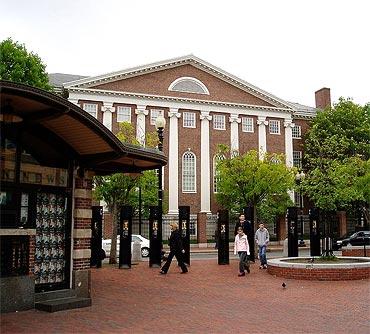
She pursued and before she knew it, was strolling along the hallowed corridors of the graduate school in Harvard, pursuing a dual degree in Public Policy and Master of Business Administration.

'I can still remember lectures from a year ago as if they happened yesterday'


Harvard University
The Harvard experience "The best ever. I can't tell you how good the case study method is. I can still remember lectures from a year ago as if they happened yesterday. Lecture-based teaching can be awfully boring. Case-studies bring life to everything. I look forward to lectures only because of case-studies," answers Lalita.
About extra-curricular activities, Lalita says: "Oh, there are plenty here but I don't take part in many. I have a son to go to at the end of the day. My class mates go abroad for internships but I don't because of my son."
Lalita is 30 today while her classmates are about 25-28. No one makes her feel old and they better not because what she has gained in the last decade by way of education and scholarships, none of her classmates have come anywhere close.
She enjoys every bit of classroom life, a privilege she missed while growing up.
Today, she has almost achieved what she set as a goal 12 years ago. Her son who is 12 happily announces to everyone that his mother is at Harvard. "He is truly proud of me and I feel fulfilled today,"Lalita said.

'How to spend and use money is very important'


Her son, Kieren, is also heard discussing his mother's accolades in school. Be it her Harry Truman Foundation Fellowship or the Dean's Gold Medallion for Civil Service or better still the College of Business Founder's Day Award. Forward, Lalita wants to write some more books for the helpless and poor besides continuing work with her NGO. She has become a bit of a celebrity already with newspapers and television channels keeping an account of her every new degree.
So what is the job that Lalita is looking forward to after graduation?
"I hope the Department of Treasury's Office of Financial Education create a special post for me. I would like to work there. Just earning money is not the end of everything, how to spend and use it is very important," the 30 year-old warns.
Till then Lalita, who is proud to have an Indian name (given by an Indian friend of her parents) will just continue to mount up her degrees. When asked about her success, Lalita always says: "In this world, you either have an excuse or a story. I preferred to have a story."

Source: http://www.rediff.com

Medicine king of Jiangnan

Rising from rags to riches, Hangzhou merchant Hu Xueyan built a pharmaceutical business that continues to flourish today. 

THERE is a late Qing dynasty residence in Hangzhou that is remarkable not only for its sheer size and its fine restoration but even more so for the fact that it is hardly, if ever, featured in the famous city’s tour itineraries.
As with all things important in Hangzhou, the mansion (or properly, manor) is situated not far from the iconic West Lake around which everything in the city seems to revolve.
The property’s original owner was a merchant named Hu Xueyan (1823-1885) who, in the late 1800s, was one of the richest men in China.
Sign of wealth: Calligraphy panels extolling the virtues of kindness and charity adorn the imposing main gate of Hu Xueyan’s manor.
Born into poverty in neighbouring Anhui province, Hu started as an apprentice in a Hangzhou bank and subsequently built up a thriving banking business. He later expanded into trading silk, tea and armaments, and finally into Chinese traditional medicine, all the while cultivating mutually beneficial relationships with high-ranking officials.
It is said that in his heyday, Hu possessed more silver than the moribund Qing dynasty, and he helped the official Zuo Zongtang pay soldiers’ salaries as well as procured provisions and ammunitions for his campaigns against the rebellions that wracked China in the late 19th century. He also generously donated money, clothing, seed stocks, rice and medicine to victims of natural disasters in various provinces.
Hu’s star rose even higher when Zuo recommended him to the Qing court and he was made an official of the second grade, just one level beneath the highest rank in the imperial bureaucracy.
Concealed behind rather plain enclosure walls several metres high, the residence that Hu built in 1872 sprawls over an astonishing 5,815sqm and comprises 13 buildings set amongst gardens, ponds and rockeries. The occupant’s wealth and status is immediately evident from the size, height and width of the manor’s soaring front porch which is designed to accommodate a sedan chair so big it had to be carried by eight men, a privilege which Hu, a grade 2 official was entitled to enjoy.
The luxurious manor was constructed using at least six types of rare and expensive wood, including cedar and sandalwood, as well as materials ranging from stone to brick to clay, much of which, like the stone lintel above a pair of doors just beyond the main gate, is intricately carved.
Huqingyutang medical hall’s plain entrance gives little hint of its grand interior.
Hu’s primary wife and mother lived in the central hall as befitting their status while the 12 secondary wives and 19 children were consigned to the wings. There is a terrace for opera performances in one of the gardens as well as a raised gazebo from which the master, his family and friends could enjoy the entertainment.
Hu was reputedly worth 20 million taels of silver at his peak, a fortune which he presumably stored in his “vault”, an underground cellar beneath one of the halls.
There is an abundance of blue glass windows throughout the mansion, an expensive foreign luxury in Hu’s day, plus an extravagant use of copper, some 20 tons of it according to our guide, for fixtures and fittings. Besides window hinges, latches, and huge water storage jars, even gutters and drain pipes were made of copper, though all but one has disappeared.
Further, in a house full of women, a copper “telephone” conduit leading directly to the wives’ quarters enabled the master of the house to speak privately with each of them.
In a side street off Hangzhou’s Hefangjie is the medicinal herb shop Hu Xueyan established in 1874, now designated a Traditional Chinese Medicine (TCM) Museum. Called Huqingyutang, one would never have guessed its importance from the simple stone entrance gate just across from a well-known scissors shop. Covered corridors lead to the beautifully maintained retail hall, a stunning double storey atrium ornately decorated in Qing dynasty style with a multitude of lanterns, carved wooden beams and calligraphy panels.
The pharmacy built its reputation on its founder’s three-pronged motto of “benevolence, avoiding deception, and fixed price”. Backed by the time-honoured values of honesty and fairness, prices were non-negotiable as they were commensurate with the high quality of the establishment’s products. Hu’s business principles proved highly successful, so much so that he is sometimes dubbed “Medicine king of Jiangnan (south of the Yangtze River)”.
Huqingyutang is a living museum, bustling with pharmacists in white coats and caps busy preparing and portioning dried herbs from the well-stocked counters and drawers, much as they would have done over a century ago. Medicinal herbs like ginseng and other traditional preparations are available for sale. In addition the company now has a modern factory producing Chinese medicine for all sorts of ailments and even an online shop and consultation service.
Hu Xueyan and Huqingyutang are evidently not unknown in China, especially since a television drama was made about his life a few years ago. This makes it all the more surprising that we were able to enjoy his lavish estate and impressive pharmacy without the usual crowds that throng famous sites in the country.

Source: thestar.com.my

6 Rags-to-Riches Millionaires

From Oprah Winfrey to Steve Jobs to J.K. Rowling, entrepreneurial success stories are the stuff from which American dreams are made. Much like these famous names, the six self-made millionaires we're profiling have one thing in common: Thanks to hard work, determination and sound advice from mentors, friends and family, they've been able to build thriving businesses from the ground up.
The rise to the top can be bumpy. In fact, some of the entrepreneurs we talked to were homeless during the early years of their companies. That's why they all agree that it's important to help others in need. All, including Radio One's Catherine L. Hughes and Life is good co-founder Bert Jacobs, give back to the community by volunteering time, donating to charitable organizations or running their own charities.
Learn how these six diverse entrepreneurs -- from a t-shirt designer to a media mogul -- turned meager beginnings into multimillion-dollar success and what advice they offer to budding business tycoons who hope to follow in their footsteps.
Catherine L. Hughes
Courtesy of Radio One
Age: 64
Occupation: Founder and chairperson, Radio One
Advice to young entrepreneurs: "Sometimes the ones who love you the most will give you the worst business advice."
By conventional standards, Hughes wasn't destined to build a successful multimillion-dollar media company. She was a teen mom by 16 and a high-school dropout. However, she later completed high school, followed by brief stints at area universities in her hometown of Omaha, Neb.
Despite her limited formal education, Hughes, who credits publishing legend John H. Johnson as one of her mentors, worked her way up at Omaha's KOWH radio starting in 1969 before heading to the nation's capital to become a lecturer at Howard University. In 1975, she became general manager for the university's radio station, WHUR-FM. By 1979, she bought her first radio station, WOL-AM in D.C., with her then-husband and founded Radio One a year later.
Those early years were rough. Hughes, who was divorced by then, slept with her son on the floor of her radio station because she couldn't afford to live anywhere else. "My mother tried her best to talk me out of the radio business because of that," Hughes recalls. It's for this reason that she advises young entrepreneurs to be wary about who they divulge their challenges to -- even family. "If I had listened [to my mother], I would be a government employee right now and there would be no Radio One."
Thirty-two years later, in addition to the radio company, Hughes' empire includes her television network TV One and several interactive ventures, including NewsOne.com and HelloBeautiful.com. Her charitable efforts include serving as a board member and the main benefactor for the Piney Woods School, a boarding school located in Piney Woods, Miss., that serves students from financially strapped families.
Bert Jacobs

Courtesy of Life is good
Courtesy of Life Is Good
Age: 46
Occupation: Co-Founder and CEO, Life is good
Advice to young entrepreneurs: "Try to shoot for a timeless business."
You've probably seen the beret-wearing, smiling face of "Jake," the Life is good logo, on the company's tee shirts and products. Co-founders Bert Jacobs and his brother, John Jacobs, 43, started peddling their tee shirts on the streets of Boston -- going door-to-door at college dorms and sleeping in their van to save money -- in 1989. It would take nearly six years, however, before their shirts finally caught on with consumers, thanks to "Jake."
The logo, which is infused with optimism, was created after a conversation about how the world was slammed with constant negativity. It became an instant hit. Now, the New England-based company has revenues in excess of $100 million, and each year more of it goes toward their charity, Life is good Kids Foundation, which helps children overcome life-threatening challenges.
"In the beginning, we made every business mistake in the book," says Bert. The brothers didn't have a business plan or growth strategy -- a formula for disaster, if you go by what's taught in business school. Bert credits part of their success to listening to their friends and customers as informal focus groups, rather than "experts." He advises budding entrepreneurs to: "Try to shoot for a timeless business that will work through good times and bad."
Ali Brown

Courtesy of Ali Brown
Age: 40
Occupation: Entrepreneur, business consultant and publisher, AliBrown.com
Advice to young entrepreneurs: "It's important you seek out other business owners for information, advice, support and resources."
Fed up with her dead-end job at a New York City ad agency, Brown decided to quit in 1998. Armed with her brother's hand-me-down computer, she launched her first marketing agency, AKB Communications, from her kitchen table.
While having her own business was exciting, the uncertainty of self-employment had its challenges. Brown remembers all too well maxing out credit cards and draining her bank account to stay afloat in the early days. One night in particular, she tried to withdraw $20 from an ATM but was denied because her balance was only $18.56. Thirteen years later, thanks to her hard work and perseverance, Brown has achieved many successes: She earned her first million before the age of 35 and has appeared on ABC's reality show "Secret Millionaire," where she donated money to several organizations. She still actively supports three of them.
When it comes down to deciding if entrepreneurship is the right move for you, Brown says, "Entrepreneurship isn't for everyone. Every definition of entrepreneur I've found includes the word 'risk'." For those who are willing to take the leap of faith, she advises: "It's important that you seek out other business owners for information, advice, support and resources. Today, would-be entrepreneurs have the Internet and social media, and it's a great place to get started learning more about how to grow a business."
Jill Blashack Strahan

Courtesy of Jill Blashack Strahan
Age: 52
Occupation: Founder and CEO, Tastefully Simple
Advice to young entrepreneurs: "Having goals is absolutely critical."
For Strahan, starting her multimillion-dollar company, Tastefully Simple, a direct sales retailer of specialty food products, began with "a dream and a shoestring." She grew up on a dairy farm in Minnesota and later started selling gourmet food baskets, which inspired her business.
In the beginning, the entrepreneur fed her fledgling company with $6,000 of her own savings and some loans from a friend and the Small Business Administration. Strahan's first headquarters was a 1,200-square-foot space with a concrete floor and no running water. Early orders were packed on a pool table. Today, the Tastefully Simple offices take up nearly 200,000 square feet on a 79-acre lot.
In addition to running a company that's valued at more than $100 million, Strahan finds time to give back to the community. Tastefully Simple has donated more than $5 million to local causes, and in 2009 teamed up with Share Our Strength, a group that seeks to end childhood hunger in America. If you're an entrepreneur with a good idea, she says to remember that there isn't an easy road to building a profitable business: "The secret to success doesn't involve pixie dust or a magic bullet. Having goals is absolutely critical."
Farrah Gray

Courtesy of Farrah Gray Publishing
Age: 27
Occupation: Founder and CEO, Farrah Gray Publishing
Advice to young entrepreneurs: "Keep your business small . . . niche yourself."
When most 6-year-olds were worried about what time their favorite cartoon came on TV, Gray was already an entrepreneur. He was going door-to-door in his inner-city Chicago neighborhood selling hand-painted rocks as bookends to help his ailing mother make ends meet. "I can remember being very young and my mom having a heart attack. I wondered how we were going to pay the bills and thought to myself, 'I don't want to be poor like this anymore,'" he recalls.
Trying to figure out a way to improve his family's home life sparked something big: By the time he was 17, Gray had founded and operated several businesses, including Kidztel, a prepaid phone card company, and Farr-Out Foods, a food company targeting young adults, which grossed $1.5 million in sales before he sold it. At 20, his first book, "Reallionaire: Nine Steps to Becoming Rich Inside and Out," was published.
Now, Gray's focused on his latest venture, Farrah Gray Publishing, a boutique celebrity book publishing house he started in 2009, which includes titles such as "Transparent" by CNN's Don Lemon. Gray also spends his time contributing to charitable organizations, such as the National Coalition for the Homeless and the National Marrow Donor Program. For anyone considering starting a new business, he suggests keeping things small: "A lot of times we get caught up in trying to be the next Facebook or Apple. That isn't necessary -- niche yourself."
Jesse Conners

Courtesy of FirednFabulous/YouTube
Age: 28
Occupation: CEO and founder, PeppermintPark.com
Advice to young entrepreneurs: "There is constantly some fire that you have to put out . . . Don't let it discourage you."
Conners had an unusual childhood: When she was 9, her parents joined a cult and -- believing that the world was about to end -- sold all of their worldly possessions. From then until she was 18, Conners traveled across the U.S. and to Mexico with her family, following the cult's message and searching for work along the way. As unconventional as it was, she says her upbringing spurred the independence she needed to succeed in business.
While in high school, she started doing the marketing for her father's chiropractor practice, which eventually led to a job in real estate. At 21, she auditioned for and was cast in the first season of NBC's "The Apprentice." Although Conners didn't win, her stint on national television landed her a job on the real estate speaking circuit. In 2008, she began building PeppermintPark.com, a membership-based fashion and luxury brand online retailer. The Web site has been up and running for a little over a year and has a ten-person staff.
Earlier this year, Conners's "outside the box" approach to business helped her to surpass a $1 million net worth. In addition to running her company, she has offered charitable support to Elephant Human Relations Aid and provides resources to women who are victims of domestic abuse, according to her Web site. Conners advises budding entrepreneurs to be aware that daily obstacles are the norm, not the exception. "There is constantly some fire that you have to put out. That's what running a business is all about," Conners says. "Don't let it discourage you. Try again, start again."

Source: finance.yahoo.com

Allo fiber leads woman from rags to riches

Around 18 years ago, when Chitra Kali Budha Magar had to fold her retail store in Domti, Pyuthan district, she had a feeling she didn´t have the ´it´ factor to become a successful businesswoman.

The experience was pretty depressing for her at that time, as the shop was her first business venture in life and its fall had also crumbled her hopes of reaching new heights in life.

Yet she tried to console herself saying the opportunity to run a store was a windfall, which was blown away by another blast of wind.

Magar, who´s now 44, had entered into business not out of keen interest, but out of serendipity.

It took place around 19 years ago, when one of her husband´s best friends gave her rice worth Rs 50,000 for free. At that time she and her husband had just migrated to Domti from their native Seuli Bang village in Pyuthan district. Since both of them were jobless, she decided to sell the rice by opening a shop.

The shop was doing fine in the beginning. Then gradually many of her customers started purchasing goods in credit. "Later, these very people started defaulting on the payment," Magar said, explaining how the fall of her store began. "And I lost almost Rs 17,000."

After the store folded up, the Magar duo migrated to Bahane Bazar, where they rented a room and started doing odd jobs like selling paddy and wheat.
This went on for around four years and in 2000 due to peer pressure she decided to join a micro-enterprise group, run by UNDP´s Microenterprise Development Program.

"Under the program, I was given a collateral-free loan of Rs 10,000 via Agricultural Development Bank Limited for which I had to pay an interest of 8 percent per annum," Magar, a high school dropout, said.

She used the money to put up a roof of corrugated sheets on four anas of land, which was given to her by a local teacher, and started running a small restaurant.
This time, her business did exceptionally well and she started making around Rs 2,500 to Rs 3,000 every three-day by selling delicacies made of water buffalo.

"Although most of the money I used to earn used to go on household expenses and tuition fees of my two children, I managed to save Rs 10,000 in a year after clearing the debt," Magar said.

Then she took another collateral-free loan of Rs 10,000 under the same program. This time she decided to venture into another business: selling yarn made of allo (Himalayan Nettle).

Allo yarn was gradually gaining popularity at that time as it was one of the crucial raw materials used in the making of hand-knotted woolen carpets and allo textile.
To collect the yarn, Magar took help of her friends and fellow villagers of Magar community, who used to hold inventories of the material to manufacture traditional costume known as ´gara´.

"Initially, I started on a small scale, selling around 10 kg of yarn per year," she said. Each kilogram of allo yarn used to cost her Rs 300, which she used to sell for Rs 400.

Gradually she started widening her customer base and the following year her sales surged to one quintal.

"Business was getting better and I had started saving around Rs 35,000 per year," she said. "But the business environment was not that great because of insurgency."

According to her, she had to pay "a tax of Rs 5 on each kg of yarn to Maoists" in those days. "The process of transporting the goods was even more cumbersome, as I used to get harassed by security personnel who used to make a mess out of our cargo in the name of security check," Magar said.

Things went on like this and the security checks and Maoists taxations started becoming regular affair for her.

Then in 2005, she took a big leap and bought a machine for Rs 70,000 to manufacture allo textiles.

Although she had bought the unit after undergoing allo textile manufacturing training for a year, she wasn´t able to reap much benefit from it as "most of the textile that I was manufacturing didn´t meet the market standard".

"Initially, I thought I was duped into buying a low-grade machine, until one of the instructors - under whom I had undergone textile manufacturing training - visited me and said I had installed it the wrong way," she said. "By that time I had already suffered a loss of Rs 100,000."

But since that time her business has been growing. Now, she sells almost 3-5 quintals of allo yarn per month for Rs 800 per kg and produces six meters of allo textile per day which she sells for Rs 850 per meter. She has also started making caps, bags, mobile pouches, table mats and ladies belts.

Over the years, she has also built a house worth around Rs 4 million on the same 4 anas of land which was given to her by the local teacher. "The price of land was around Rs 40,000 at that time which I have already returned," Magar said.

Now, two of her sons have also grown up and are studying in Kathmandu. She spends almost Rs 30,000 per month on them. "And after deducting all the expenses, I can save around Rs 100,000 per year," Magar, who was recently elected as the president of National Allo Entrepreneurs Association, said.

For her, life has been good so far but she fears a weed known as ´banmara jhar´, which is growing in the forest, may destroy allo plants in the forest in her hometown. "If the plants are destroyed, it will have direct impact on our business as well as livelihood," she said.

Source: myrepublica.com

Saturday, October 1, 2011

Rags to Riches

Elizabeth Wambui Njeri, 23, has had a hard knock life but through it all, she held her head high and persevered. She gives her real life story of struggle and triumph to SHIRLEY GENGA
Where did you grow up?
I grew up in Gikambura Village, in Kiambu County. My mother was a single mother with three kids and we all stayed with my grandmother. I am the eldest girl followed by my sister and my younger brother. My mum worked in Nairobi as a secretary and she would commute to and fro daily. She was not well-paid, but we survived because in ushago, you get food from the shamba, you do not pay rent and electricity is cheap. While I was a Form two student at Loreto Kiambu High School, my mother moved us to Nairobi.
How did your life change?
Everything changed; life became a struggle. After my mum paid rent, electricity and food, there was nothing left from her salary. We had to grow up very fast. We lived in a small house in South C and it became the norm for me to be sent home for school fees .
In fact, when the headmistress would call out the names of students being sent home, I automatically knew I was among them. I remember I would get so depressed. I would be sent home then come back and try and catch up. The following term, the cycle would repeat itself.
What happened next?
Life continued got worse. Once when my other siblings had gone up-country for holidays, auctioneers came to our house and left us with nothing but a bed. Soon after, I was also sent up-country and I remember not having the strength to tell my siblings that they had nothing waiting for them when they returned to Nairobi.
What did you do after you completed high school?
In 2006, I joined Regional Centre to pursue a cabin crew, PR and Japanese course but due to lack of school fees, I was unable to complete them. I stayed for a year and was in and out because of school fees. I was finally forced to leave. I felt as if my life was not changing, as I was still going through the same high school cycle.
What did you do after leaving college?
I immediately started looking for a job. At the time, my younger sister was in high school and watching her go through what I went through was difficult. She was the student always being sent home for school fees, who did not have shopping, it was so hard. I got temporary jobs as a sales promoter. I think I did all the sales promotions in the world.
I would promote different products outside supermarkets and get paid Sh1,000. At around that time, my mum lost her job so we had to move to a small two-bedroomed house in Umoja. We only had one bed and because my mum refused to sleep on it, my small sister would sleep on it and my brother and I would sleep on the floor while my mum would sleep on the sofa.
That is how we lived for the three years. I would never bring anyone to our house because I was embarrassed. From then on, we lived in debt because my mother never got another stable job. If I can remember, even drinking milk was a luxury for us.
Did any of your friends know about your situation?
The greatest lesson my mother taught us through it all was that just because life was hard, it did not have to show n you. I would go to Mtindwa and Gikomba market and buy nice cheap clothes. Looking at me, you would never know where I was from. Only those closest to me knew of my struggle. Just because you do not have, does not mean everyone has to know. Just do the best with what you have and hold your head high up.
What were you hoping to achieve at that time?
Other people have dreams to be doctors or lawyers, but I knew that I was limited by my education thus the next best thing for me was to be a flight attendant. The house in Umoja had a balcony and from it, you could see aeroplanes passing by and I would cry out to God and beg him to give me a chance. I borrowed a directory and wrote down all the airline information I could find on the yellow pages. I sent my CV to all the airlines. One of my privileged friends tried to discourage me; he told me that airlines only took light skinned girls or girls with nice legs and not skinny ones like mine. It hurt so much but I did not really despair. I had a dream and somehow I knew God would come through for me.
My mum never got another secretarial job; she had so much on her back because my siblings were still in school. She lost so much weight as a result. She would sometimes get manual jobs at industrial area and would walk there everyday. Everything she got she gave us, a lot of times forgetting herself. I remember once while I was doing a promotion job in Westlands, she walked from Umoja to Donholm, got on a matatu for Sh20, then walked from Muthurua to Westlands just to give me Sh100 for transport back home in the evening.
She had gotten some money after I had left for work and she did not want me to struggle going back home in the evening. When I saw her, I just broke down and cried. I did not transport to go back home but God always provided. I remember promising myself that the day God would bless me with a good job, my mother would live like a princess.


A lot of young women look for �sugar daddies� to help them along the way why did you not choose that path?
My mother taught me to love myself and I promised myself a long time ago that I would never go that direction. I got a lot of offers and the men I refused would laugh at me and tell me that I was not as special as I thought and that I would be back.
Did life change in 2008?
No, it got worse. I would meet with some of my former schoolmates or friends who were in college or university and I would feel like dying. Here I was, struggling to help my family but they had the luxury to go to school (laughs). Their only duty was to pass their exams. I began to attend church at JCC Buruburu, gave my life to God and even became an usher. The year 2008 turned out to be one of the worst years of my life. I had continued applying for a cabin crew position everywhere but nothing seemed to be coming up. My life felt like it was falling apart. We were still going through the same struggles; my mum had still not gotten a job, my sister had just completed high school and watching her cry because there was no money for university was unbearable. I think she was even becoming a little depressed; she would lock herself up in the room and cry.
Elizabeth Wambui Njeri
By the end of 2009, I was in a very dark place in my life. I felt hopeless. I had been waiting for something, anything to change but nothing had happened. That December, I travelled up-country to reflect. I remember in the evening, I would go out and sit alone and cry about my life. Once when I was sitting outside, I remember praying to God and asking for a sign that I would get my dream job and as I sat there crying, a plane passed and I knew that everything would be okay.
A few days later on December 26, I got a call asking me to report to my dream job at an international airline. After some training, I began working as cabin crew on January 2010 in Dubai. The airline paid for everything from my relocation to my flight there. I now live in Dubai and the only thing I spend my money on is food.
How did this change your life?
The first thing I did was pay my mother�s debts. After I was done, I moved her from Umoja to a big house in South C. I have made sure her room is huge and luxurious, I never want her to suffer again. My two siblings also have their own rooms and I am paying school fees for my sister, who is doing a degree in psychology at Nairobi University and for my brother who is in Shan Tao College. The other day, they all came to Dubai during the holidays and it feels so good to be able to do these things for my family.
What was the first thing you bought for yourself?
After the auctioneers came to our house, we never ever owned a good television or radio, the first thing I did was buy myself a 42-inch flat screen TV. I have always loved clothes and fashion and to live in a country like Dubai where you can get the latest styles, is like being in heaven. I never had nice things growing up so being able to buy myself stuff is truly a blessing from God.
How do you keep yourself grounded?
I have a personal relationship with God and he keeps me grounded. A lot of girls come to Dubai and get lost in all the raha here and by the time the job is over, they come home with nothing. I know how far I have come so I work hard and keep out of trouble. I have recently been promoted from economy class to business in a span of one and a half years, while most people take three years. Apart from hard work, I try to use my money wisely and invest and I even bought some land in Kitengela.
What are the perks of your job?
I have been to the whole of Europe, Australia, New Zealand, Japan and many other places. The other day, I got the chance to visit Disneyland in Tokyo and it felt wonderful to fulfil one of my childhood fantasies.
Are you dating?
Yes I have been dating the same guy for six years now. I remember he would buy me bread with his pocket money back in the day when bread in our house was like manna from heaven (laughs). He is a wonderful man.
Advice to other young girls?
Do not take the short cut, just work hard and give God your dreams and he will do more than you could have ever imagined.

Monday, September 26, 2011

A real rags to riches tale!


Ramesh Babu started up as a barber giving haircuts for Rs 5 in 1993, today he is the owner of a 154 imported cars including a Rolls Royce. What is the magic?


Driving around town in an iconic luxury car is the stuff dreams are made of, but Ramesh Babu always believed in the power of dreams. 


His journey is so unusual, it almost seems unreal; from earning Rs 5 per hair cut in his father’s humble barber’s shop in Bangalore to a booming travel and tour business. It all started in 1993, when Ramesh’s life took a U-turn.
He bought a Maruti Omni Van for personal use which he later started renting out. Sensing the potential car rental business had, Ramesh decided to focus on the travel business. Today, he has a fleet of a 154 luxury cars that includes brands like Mercedes, BMW, Volkswagen and even a Rolls Royce.


Ramesh Babu, MD, Ramesh Tours & Travels says, “My father passed away in an early age. My mother started working and brought us to this stage. My father had left us a saloon in Brigade Road, which my father had started. When my father passed away, it was given to someone to run the show and he used to pay only Rs 5 a day. After my college, I took over the saloon thinking to get into businesses of saloon. So, I started saloon business between 1989 and 1990. In 1993, I bought a car, Maruti Omni Van for my personal use. Later on I realised that if I keep it for myself, it doesn’t work. And then I started renting it out to a company called Intel, that was my first customer. That is how I started growing in car rental business.” 


Ramesh has already grossed revenues of Rs 10 crore and has clients like Hero Honda, Biocon, Tata Elexi, Maruti, ICICI Bank and Jet Airways. But instead of chasing volumes, he has always focused on targeting margins.


Babu says, “When I first picked up the van it was Rs 12.50 a litre, now it is Rs 70, almost six times the rate. But still the price for the Maruti Van per km is only Rs 5. That is the reason I thought getting into small cars. Then I thought let me concentrate on high-end cars. In 2004, when we picked the first Mercedes E Class, it was the first of its kind in South where the Mercedes brand was not available for commercial purpose.”
While margins, higher rising costs are certainly hurting growth, but the show must go on. 


Babu says, “We are planning to open branches at least in four more cities like Bombay, Delhi and Hyderabad and Chennai. Chennai, we have few cars already running. But we don’t have an office there. We will start office there by this year-end. In another five years, I should have atleast 200-300 luxury cars all over India.”

Source:moneycontrol.com

Wednesday, September 21, 2011

One Multimillion-Dollar Success Story

By providing small businesses with incubators, Israeli industrialist Stef Wertheimer hopes to give Israelis and Arabs economic opportunities that will lead to peace

About five years ago, Stef Wertheimer came across Gamila Hiar, a Druze woman with no formal education who had learned the ancient art of making soap from wild herbs and olive oil as a child. At the time, Hiar was supplementing her family's income, producing about 500 soap bars a week, from a corner in a room underneath her house in Pqi'in, a village in the Galilee region of northern Israel.

When Wertheimer met Hiar, her soaps had a devoted local following and were referred to as "the magic soaps of Gamila" for their restorative properties. Wertheimer was impressed. "We found that she was an entrepreneur," says Wertheimer. "She just needed more space to dry her soaps. I asked her if she wanted to come to one of my industrial parks."

Developing Exports

Hiar, now 68, ended up at Tefen Industrial Park, a bold philanthropic enterprise located about eight miles from the Lebanese border. Wertheimer , the founder of Iscar Metalworking, established Tefen in 1985 in order to encourage entrepreneurship in one of Israel's most undeveloped and low-income regions, with a population split largely between Arabs and Jews. According to Wertheimer, 81, "there are no unemployed, only people who are unlucky to find a job."

The Tefen model is based on a business and social incubator concept. In a country with few natural resources and a tiny domestic market, its purpose is to help develop businesses that manufacture for export. Startups are given space to rent and a number of business and administrative services (usually at reduced fees or for free) such as help in business planning, marketing, and entrepreneurship, and access to postal and banking facilities. Although many of the companies are small, the park's structure allows each firm to operate and export on a much larger scale than it could were it operating independently. After a company has established itself, it is expected to leave and become independent. On average, the companies stay between 5 and 10 years. That allows new businesses to take their place.

Currently, Tefen houses 21 companies employing 500 people—many of them Arab and Druze. They include a research and development arm of SanDisk , a flash memory device company with worldwide sales of $3.9 billion, a glassmaker, and Kolsint, a maker of lenses for imaging cameras for nuclear medicine that reportedly supplies 50% of the world market. Tefen is also home to Iscar's headquarters and its bright yellow high-tech plant where whistling robots travel the factory floors. In May, 2006, Berkshire Hathaway's Warren Buffet acquired an 80% stake in Iscar for $4 billion .

Gamila Secret occupies a 12,916-square-foot facility within Tefen's 30-acre campus and produces some 15,000 bars of soap a day. The company employs about 20 workers, all of whom come from Gamila's home village of Pqi'in.

The company, managed by Gamila's two sons, Fuad and Imad, generates roughly $8.4 million in sales in 20 countries including Japan, Germany, and Britain. Fuad expects sales to triple by 2009 and is looking to begin distribution in the U.S. He credits Tefen for the little company's widespread success. "Stef saw that this was a unique and special product," he says. "The location at Tefen gave us huge worldwide exposure. Our big problem now is to double our production each day."

Job Creation and Education

Since Tefen, Wertheimer has established four additional industrial parks in Israel following the same model. To date, they have nurtured 175 companies, employ 5,000 people, and in 2007 produced collective sales of $750 million, 80% from exports. In 2003, Wertheimer established his sixth park, in Gebze, outside of Istanbul, Turkey. Today, Gebze has 70 companies employing 300 people.

In 1994, after eight years in the Israeli Air Force, Guy Cohen joined a group of about 20 former officers at Tefen. Wertheimer offered the group education, provided equipment, a workshop, and a basic salary. Cohen worked there for about two years preparing dies and molds for the plastic injection industry. "We had lectures and daily meetings with Wertheimer," says Cohen. "We were working like a private company that had to make a living. We had to make a product, find customers, and make a profit."

After about three years, Cohen decided to start his own company, Metalicone, a manufacturer of industrial metal precision parts, at the Lavon Industrial Park just south of Tefen. Last year, Cohen says, the 100-employee company, which exports to Germany and Switzerland, had $15 million in sales. "The two most important things I learned from Stef was to take pride in your work," he says. "You don't have to invent yourself. Try to make what is out there but do it even better."

According to Wertheimer, job creation works when it is combined with ongoing educational opportunities. Thus, education makes up a large part of the offerings at his industrial parks. In 1964 he established an industrial school providing technical education for young people (many of whom were dropouts and many of whom today are managers at Iscar and other companies). Wertheimer also initiated an educational system for the entire Galilee region offering computer courses, mentoring, and vocational training.

In 2000, Wertheimer, in conjunction with Tel Aviv University, launched the Arab-Jewish Entrepreneurship Course for fledgling entrepreneurs from across the country. Since its inception, some 230 students have attended the program. The course spawned several successful ventures including a chain of diet workshops launched by a female Arab entrepreneur who plans to expand into Jordan, and a joint Israeli-Palestinian company that makes premium olive oil.

The "Capitalist Kibbutz"

Wertheimer's parks look nothing like industrial zones. They are filled with clipped lawns and open-air sculpture gardens. Tefen includes a handful of art museums, and numerous concerts and festivals take place on the grounds. Several of the parks are located near manicured residential areas that Wertheimer established. It was Wertheimer's intention to showcase the beauty of industry and break the stereotype of manufacturing as something dirty and low-rent. For instance, at Tefen's dining room, waiters serve workers free lunch on cloth-covered tables. "I call this a capitalist kibbutz," says Wertheimer.

In Werteheimer's grand scheme, a host of similar industrial parks would stretch across the Levant, the non-oil producing nations along the spine of the former Ottoman Empire, through Lebanon, Turkey, Jordan, Palestine, and Israel. "There are 90 million to 100 million people quarreling about who's right," he explains. "Israel is more successful than the Arabs, and I believe peace will come if we have similar income levels. This we can have, but we have to change from an agricultural society to an industrial one. It can be done. We've done it here in the Galilee, which is 20% of Israel. It is made up of Arabs and Jews, and unemployment is 4% here compared to 7.5% in Israel."

Wertheimer's vision hasn't always lined up with events on the ground. In 2000, one week before a groundbreaking ceremony was to take place at a joint Israeli-Palestinian industrial park outside of the Gaza Strip, the Intifada erupted, scuttling plans for the park that eight years later have yet to be revived. Similarly, plans to launch a park in Jordan have been shelved.

Still, he hasn't given up. "I'd like to see more neighbors put up more Tefens," he says. In the near future, Wertheimer has plans to create 10 additional parks in both Israel and the Palestinian Territories.
As he takes in the sweeping views of the Galilee and the hills of Lebanon (which were recently the scene of a ferocious war between Israel and Hezbollah), he says that the European Union or the U.S. needs to take an active role in pushing his vision forward. In 2002 he presented his ideas before the U.S. House of Representatives advocating a kind of Middle East Marshall Plan that he says would ultimately replace poverty and terrorism with a better quality of life and jobs. In March he met with German Chancellor Angela Merkel. "I want everyone to have a job and to be busy. There will be no terrorism. I want an anti-oil story where we become rich through industry." After all, he says, "entrepreneurship comes down to opportunity."

Source: Businessweek.com